

Product
LiveRelay
A control room for multi-agent AI workflows: agents pass work along a visible canvas, every step and cost is traced, and nothing ships until someone signs off.
Facts
- Status
- Live
- Platform
- Web app + mobile
- Flows
- Canvas · Runs · Agents
- Models
- Claude Opus 5.5 · Sonnet 5 · Haiku 4.5, set per agent
- Year
- 2026
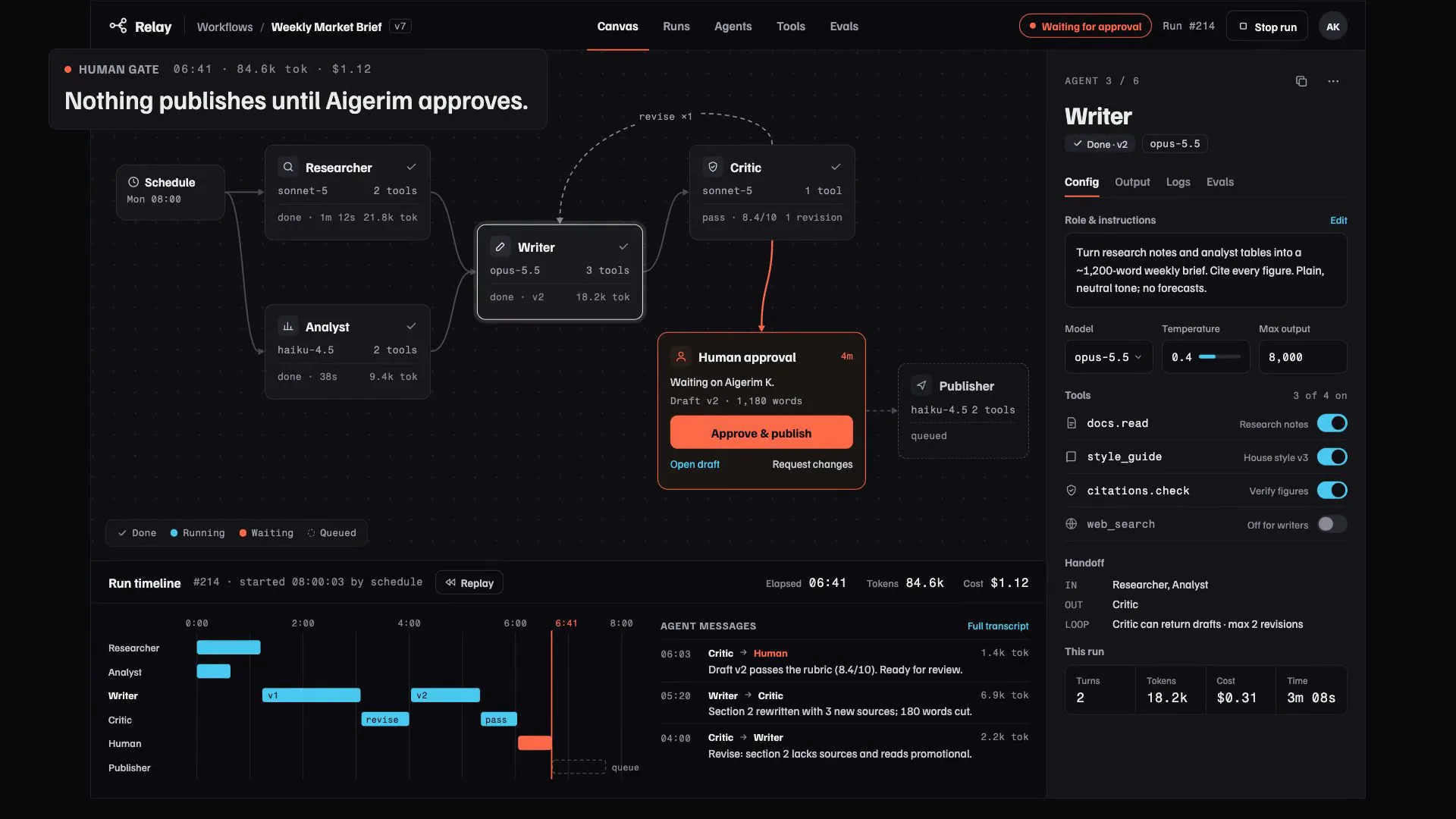
FIG. 01 / PRODUCT FILM
Muted preview · play with sound for the full cut
Who it's for
Teams that run AI agents on recurring work that goes out under their name, such as a weekly brief, a report or a subscriber email. For the person who has to sign off and answer for what each run did and cost.
The problem
Multi-agent pipelines are hard to trust. Work passes between models nobody watches, a weak draft or a failed step surfaces only at the end, and afterwards no one can say what a run cost, which agent did what, or who approved what went out.
The product
Relay draws the workflow as a wiring board: each agent is a card with its role, model and tools, and the wires show who hands what to whom, including a critic that sends a draft back to the writer when it falls short. Every run is traced on one clock: turns, tool calls, handoffs, tokens and cost per agent. Guardrails cap revisions and spend per run, and a human approval gate sits before anything is published; the run waits there until someone signs off.
FIG. 02 / HOW IT WORKS
How it works
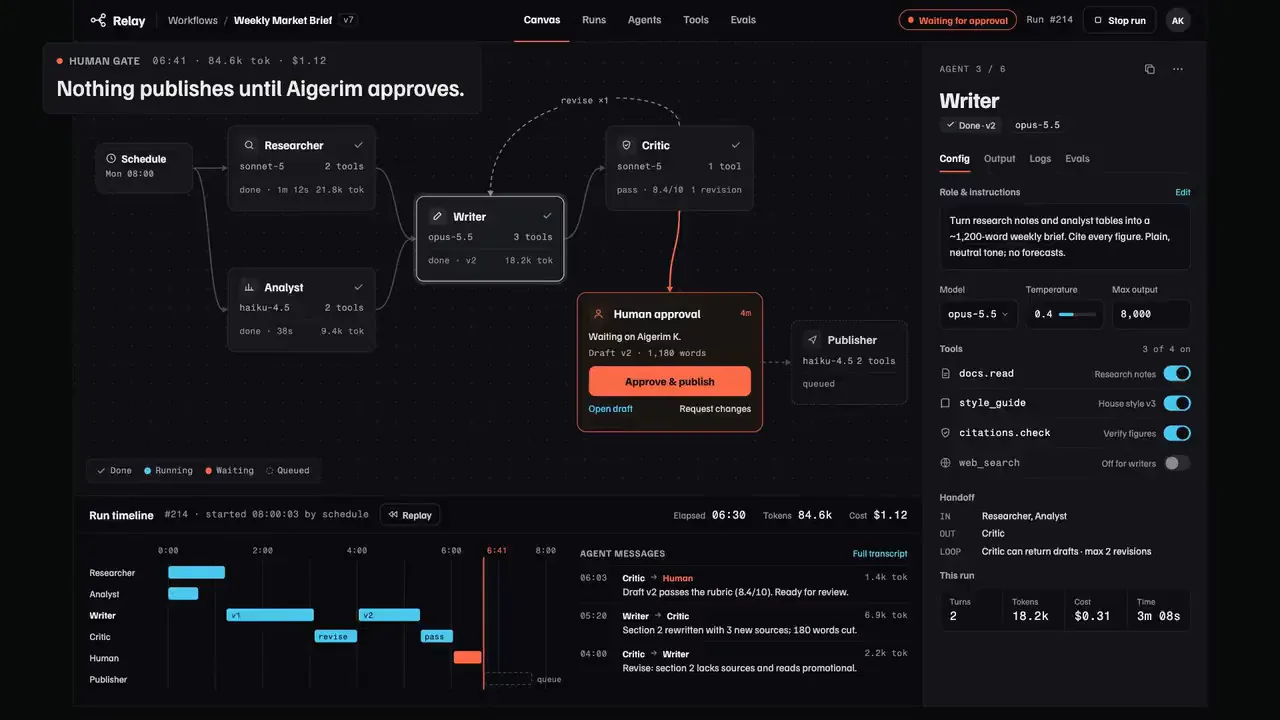
Step 1: Canvas
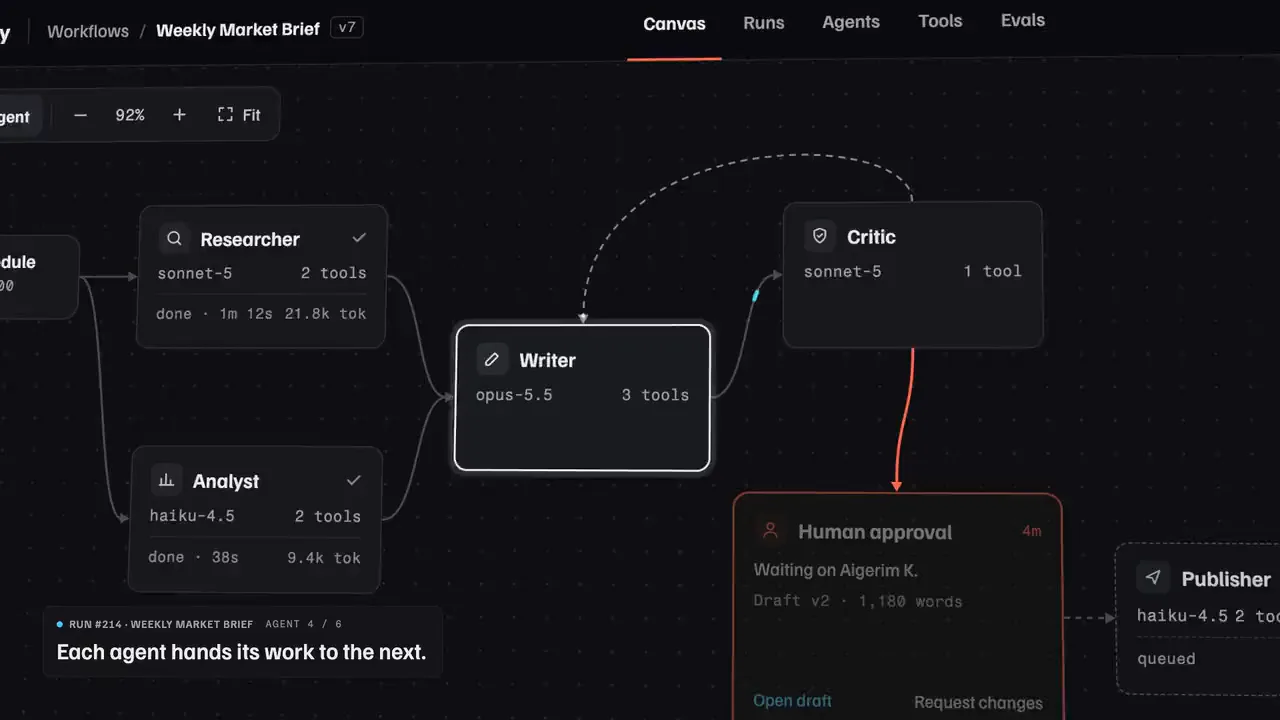
The canvas lays the workflow out as a wiring board: a researcher and an analyst run in parallel, a writer drafts, a critic scores the draft and sends it back if it falls short, and a human gate holds the result. The inspector shows the selected agent's instructions, model, tools and what it cost in this run; the timeline underneath keeps every turn on one clock.
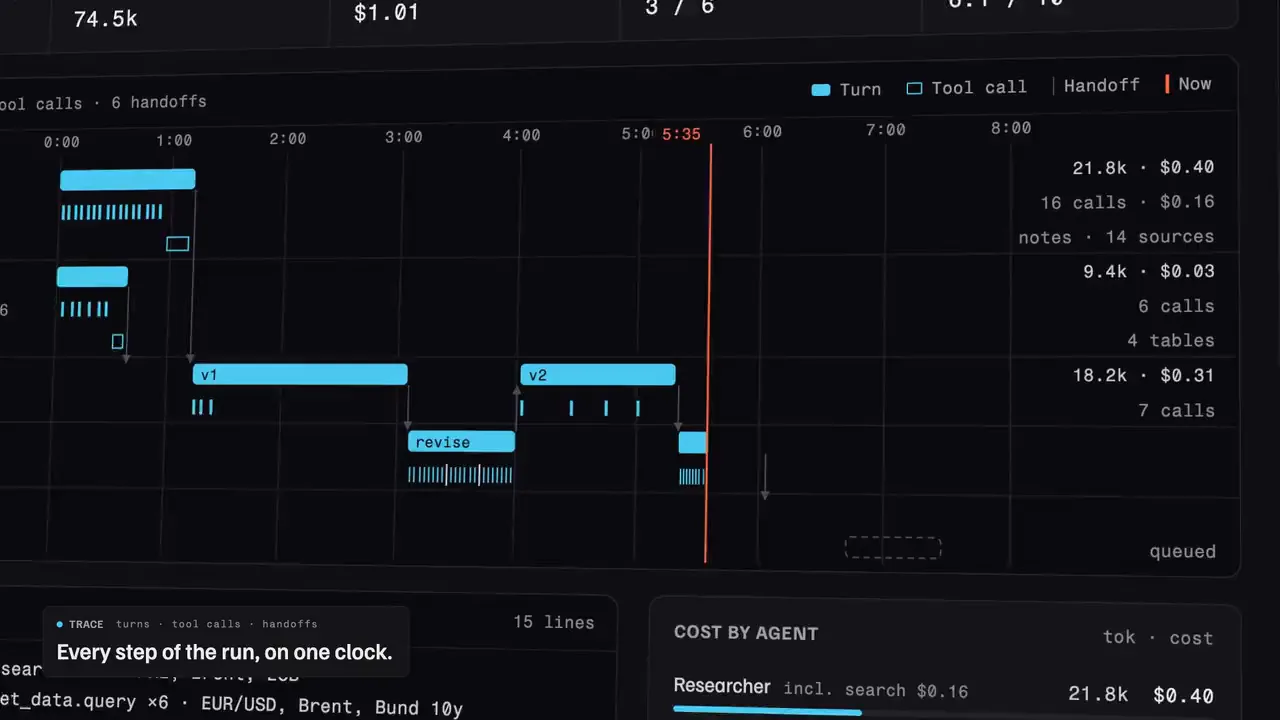
Step 2: Runs
Every run plays back on one clock: a trace of turns, tool calls and handoffs per agent, tokens and cost adding up as it goes, and a run log that reads like a terminal. The run stops at the approval gate; approving releases the publisher and closes the run with its final totals.
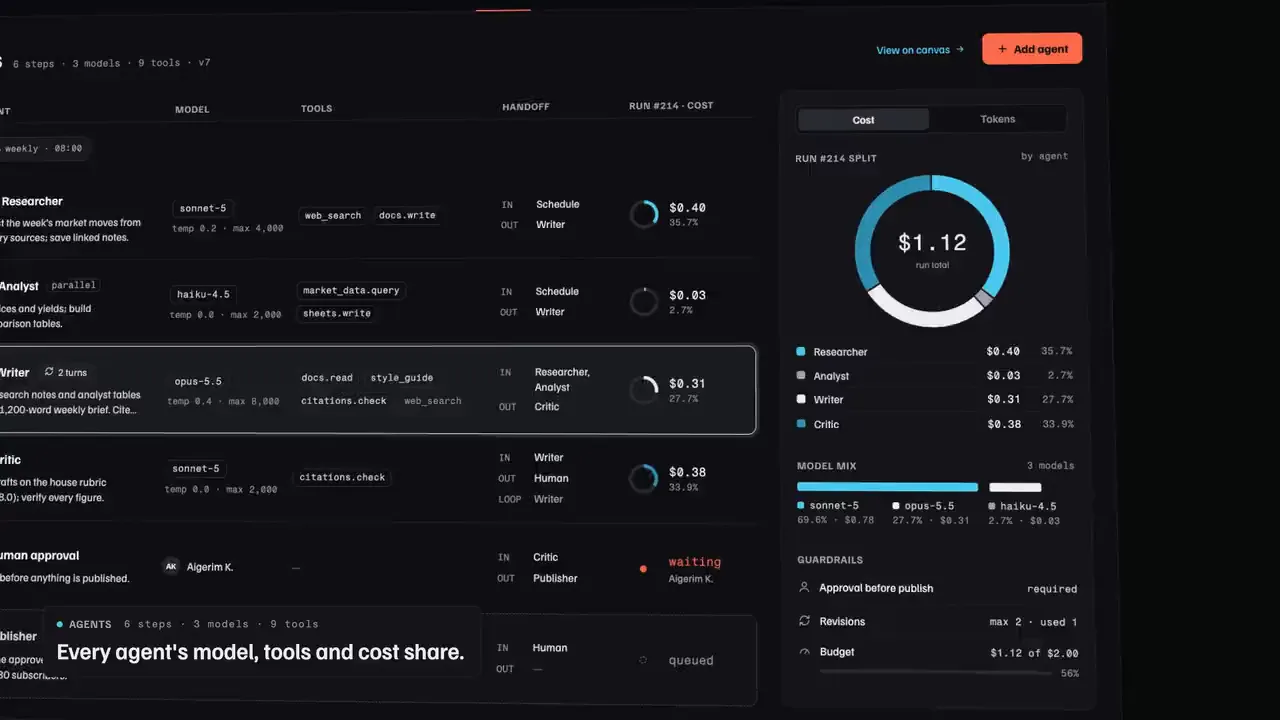
Step 3: Agents
The roster shows who does what, with which model and tools, where each one hands off, and each agent's share of the last run's cost, next to the guardrails every run obeys: approval before publishing, a limit on revisions and a budget per run.
FIG. 03 / SCREENS
The product, screen by screen
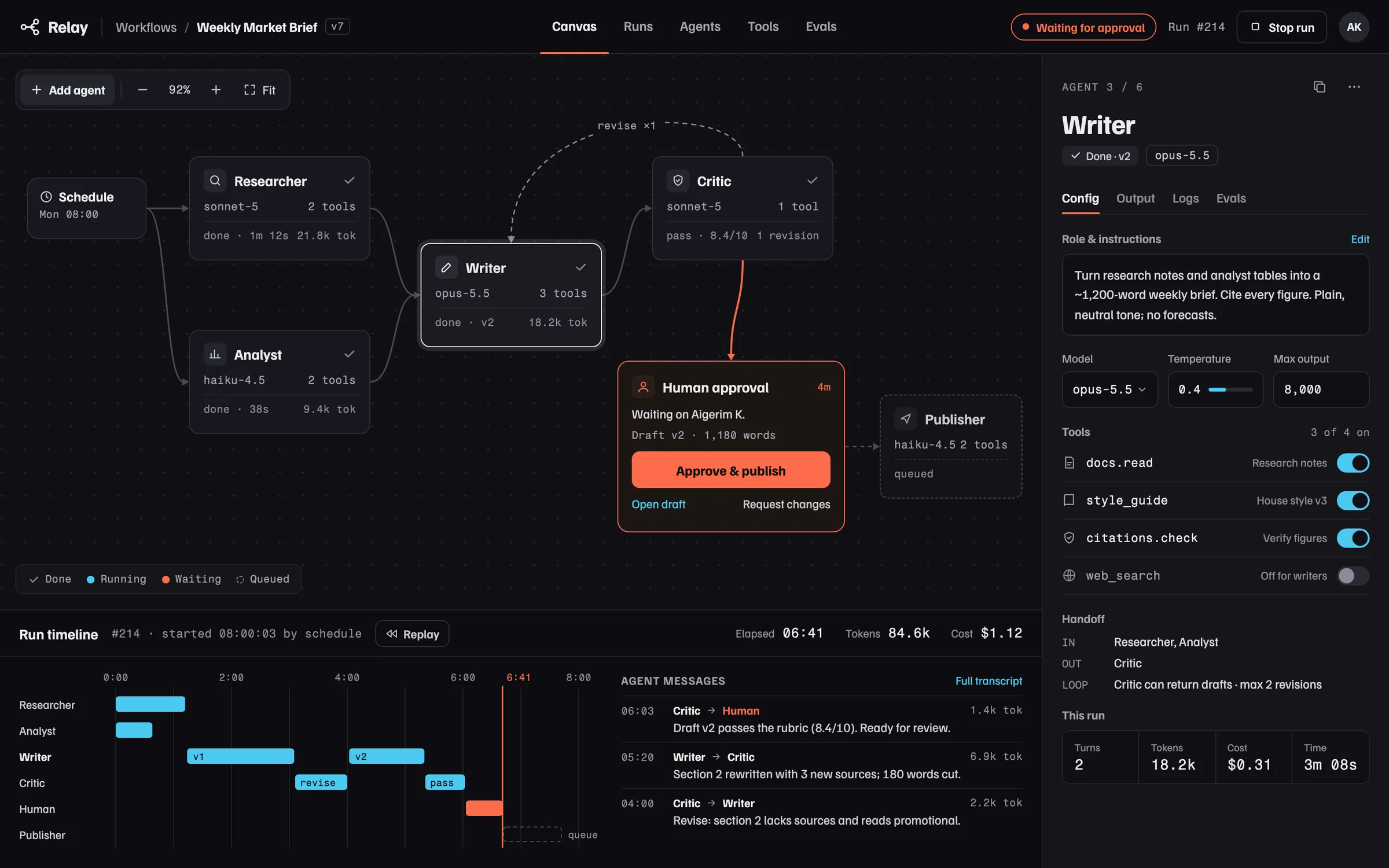
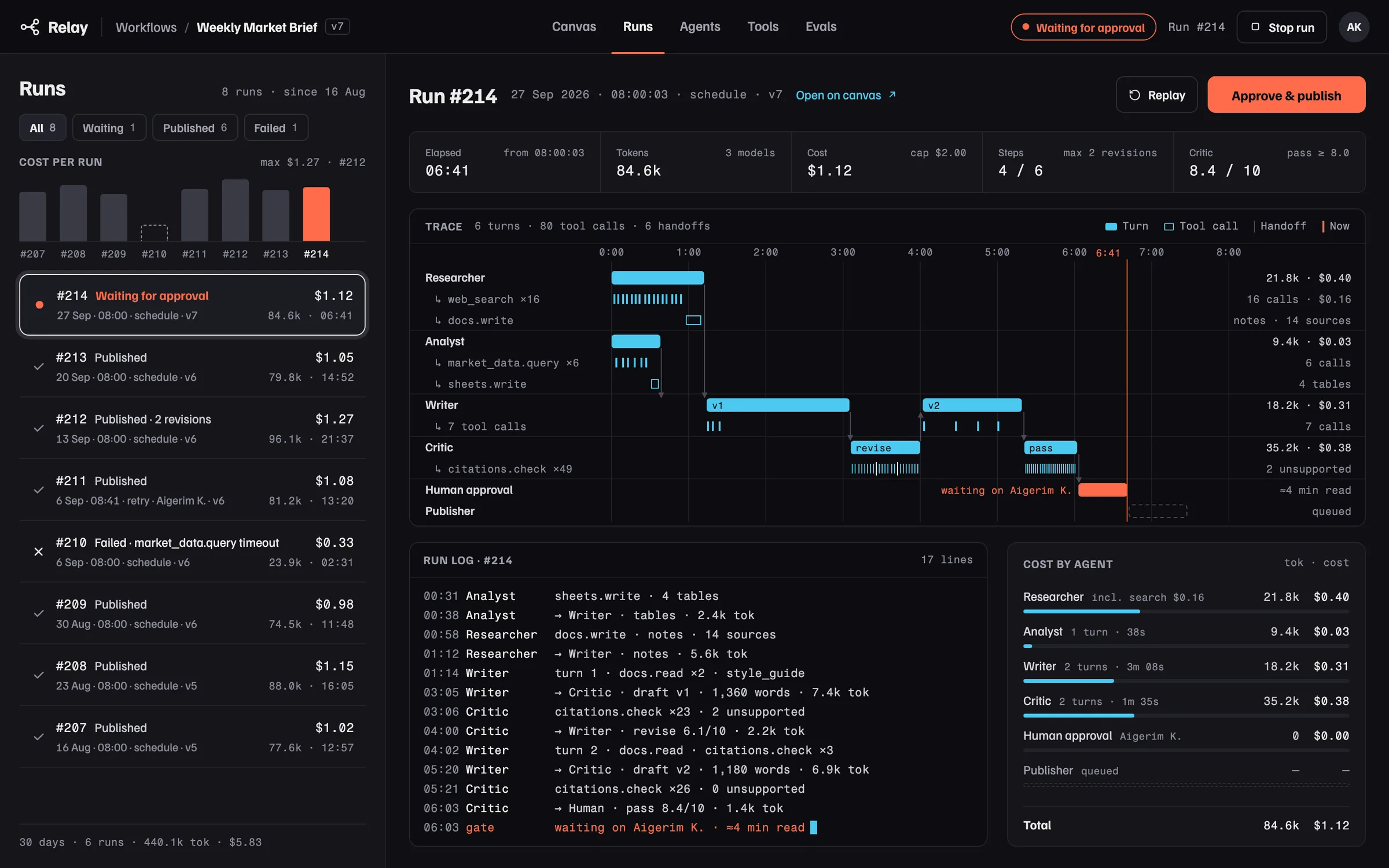
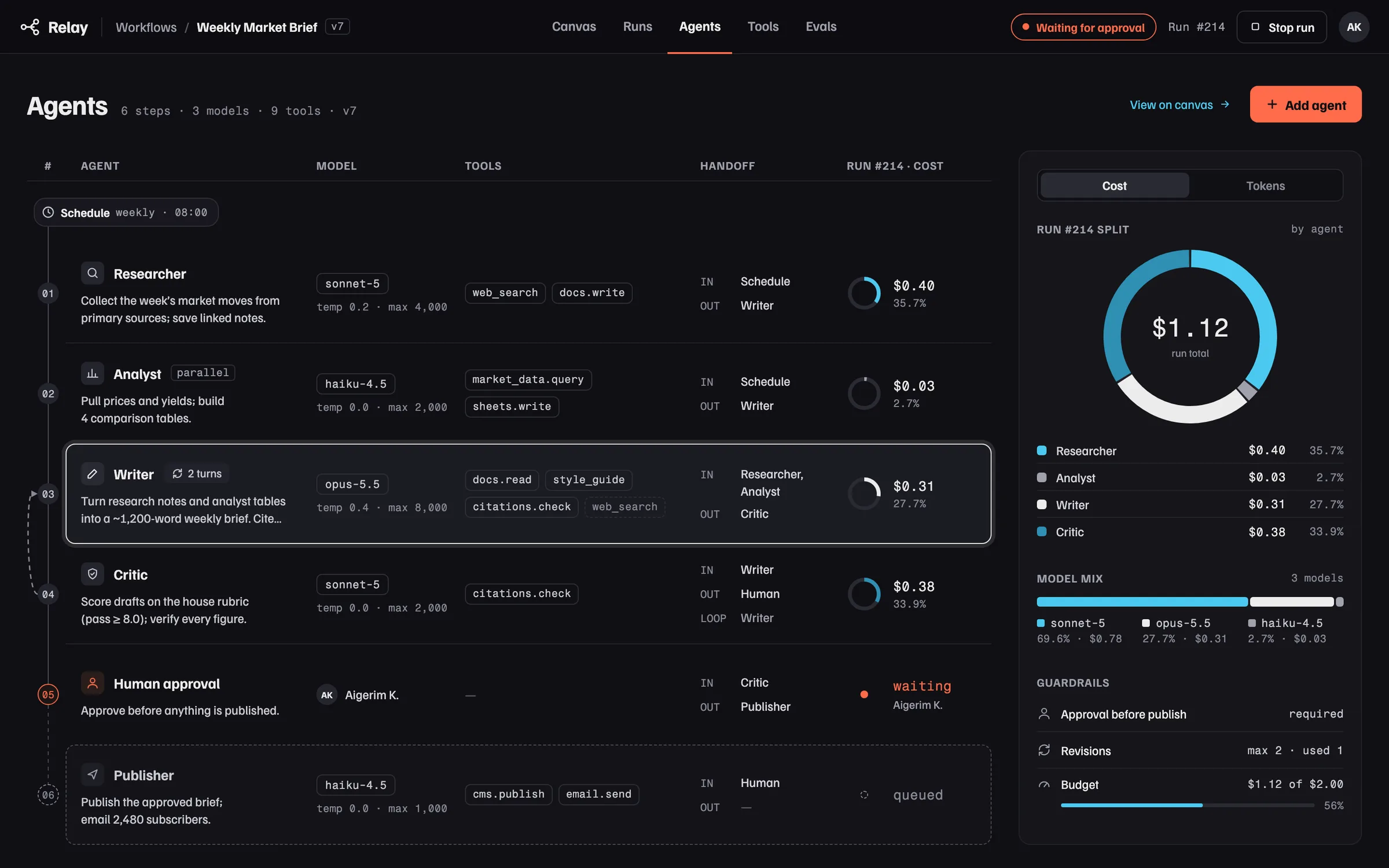
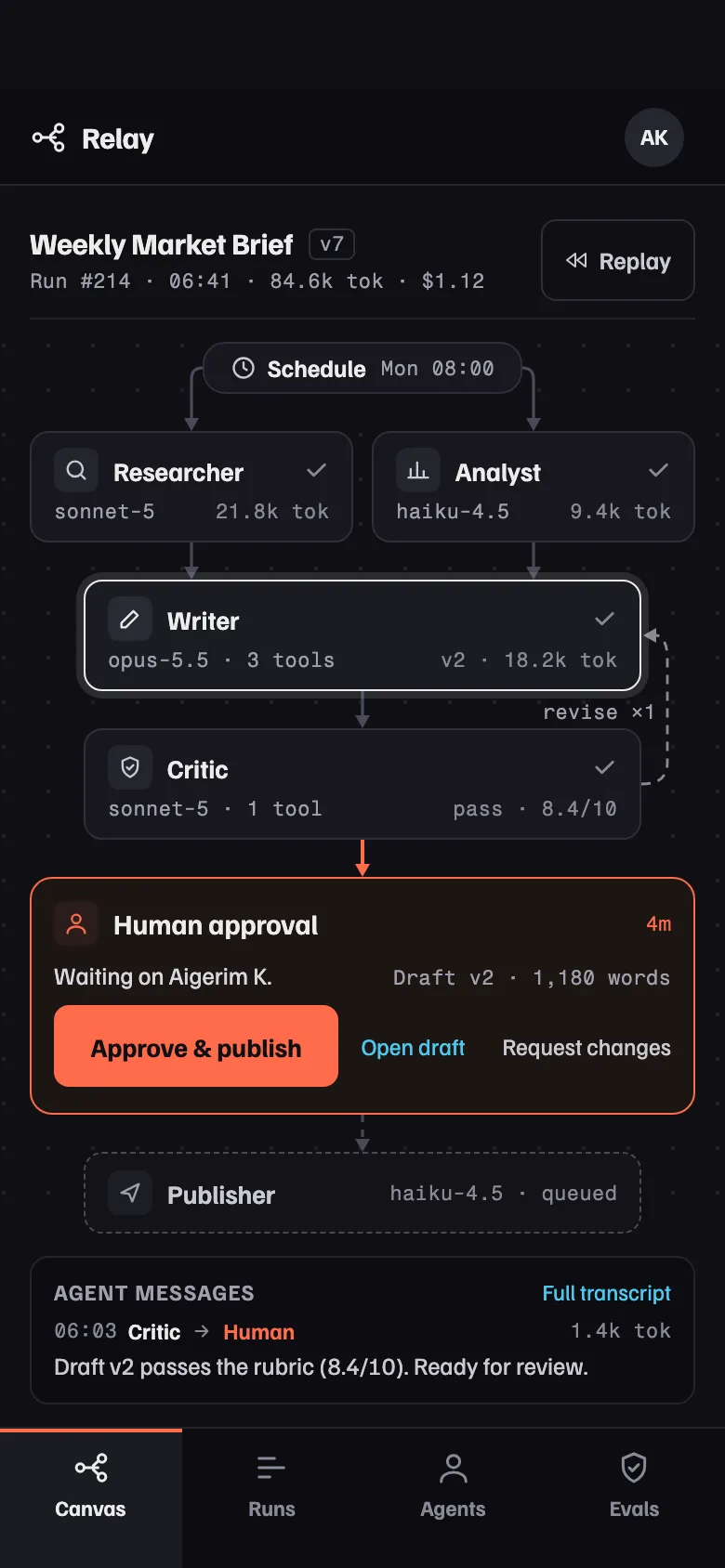
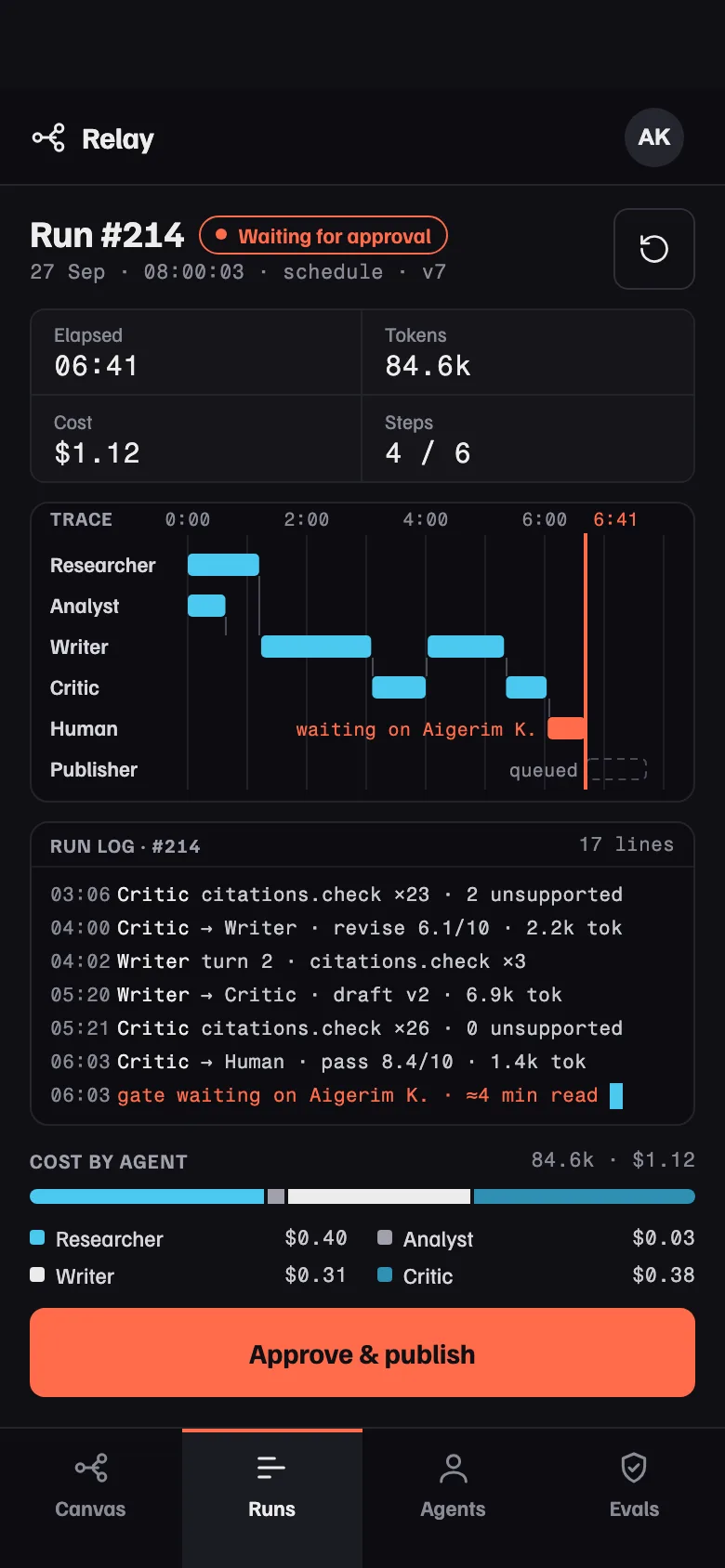
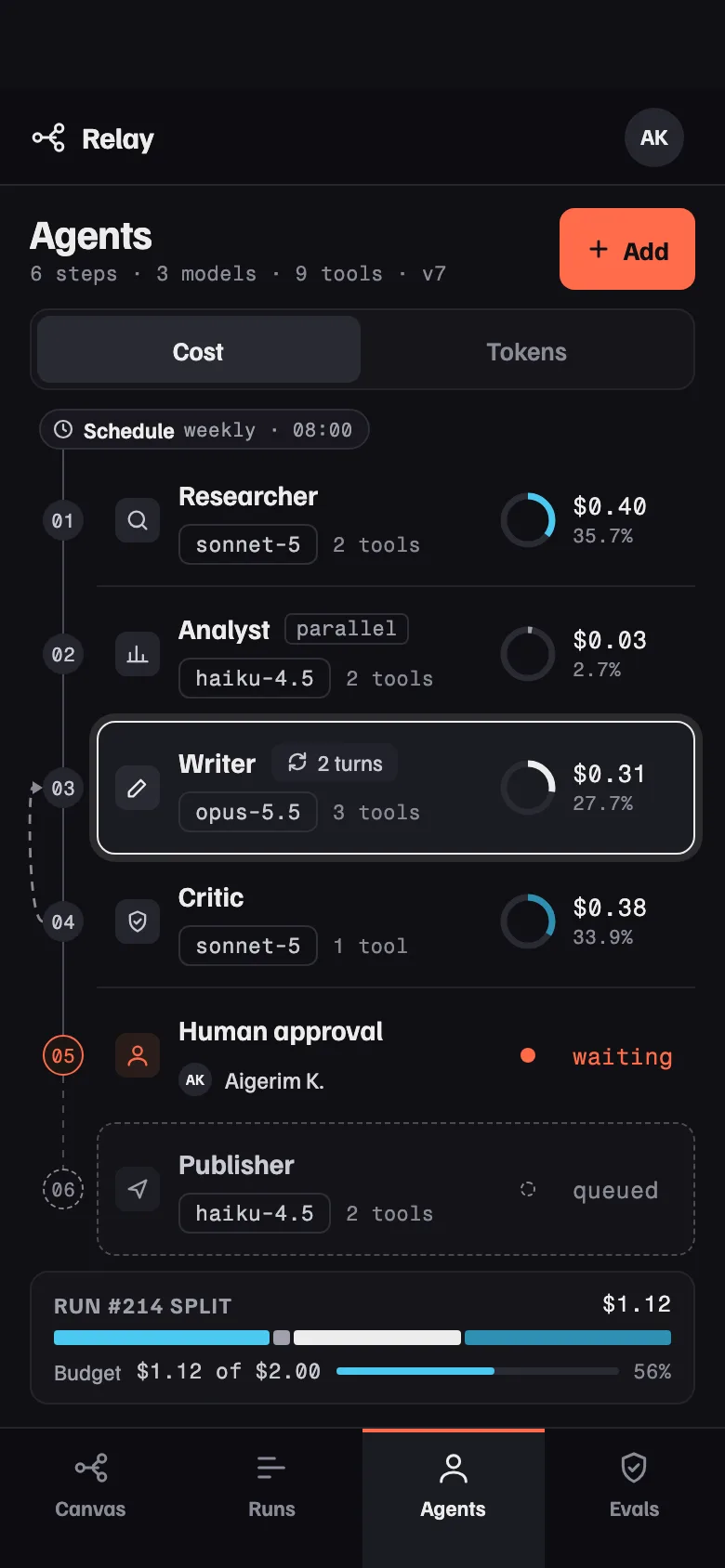
FIG. 04 / DESIGN DIRECTION
Design direction
A dark control room, calm and precise. Familjen Grotesk carries names and actions; Fragment Mono carries everything the system reports — models, tools, timestamps, tokens, cost. Colour is state: cyan while an agent is running, coral for anything waiting on a person, quiet grey for done and dashed outlines for queued, so one glance at the canvas tells you where the run is. No gradients and no glow; the only highlight is the ring around the selected agent.
Palette
- Night#101014
- Text#ECECEC
- Cyan · running#4CC9F0
- Coral · waiting#FF6B4A
- Meta#8A8A96
Type
- Familjen Grotesk
- Names, titles and actions
- Fragment Mono
- Models, tools, timestamps, tokens, cost
FIG. 05 / MOTION LANGUAGE
Motion language
“Baton relay”: work moves like a baton on a lit wiring board. The wiring is there from the first frame and never draws itself — only work moves along it. A ring fills around an agent while it works, a packet slides down the wire to the next card, and a draft sent back travels the dashed revision loop. Counters tick in plain monospace, spans grow on one shared clock, and when the run reaches the human gate everything holds; the gate breathes once every few seconds while it waits.
Related systems
Kiko
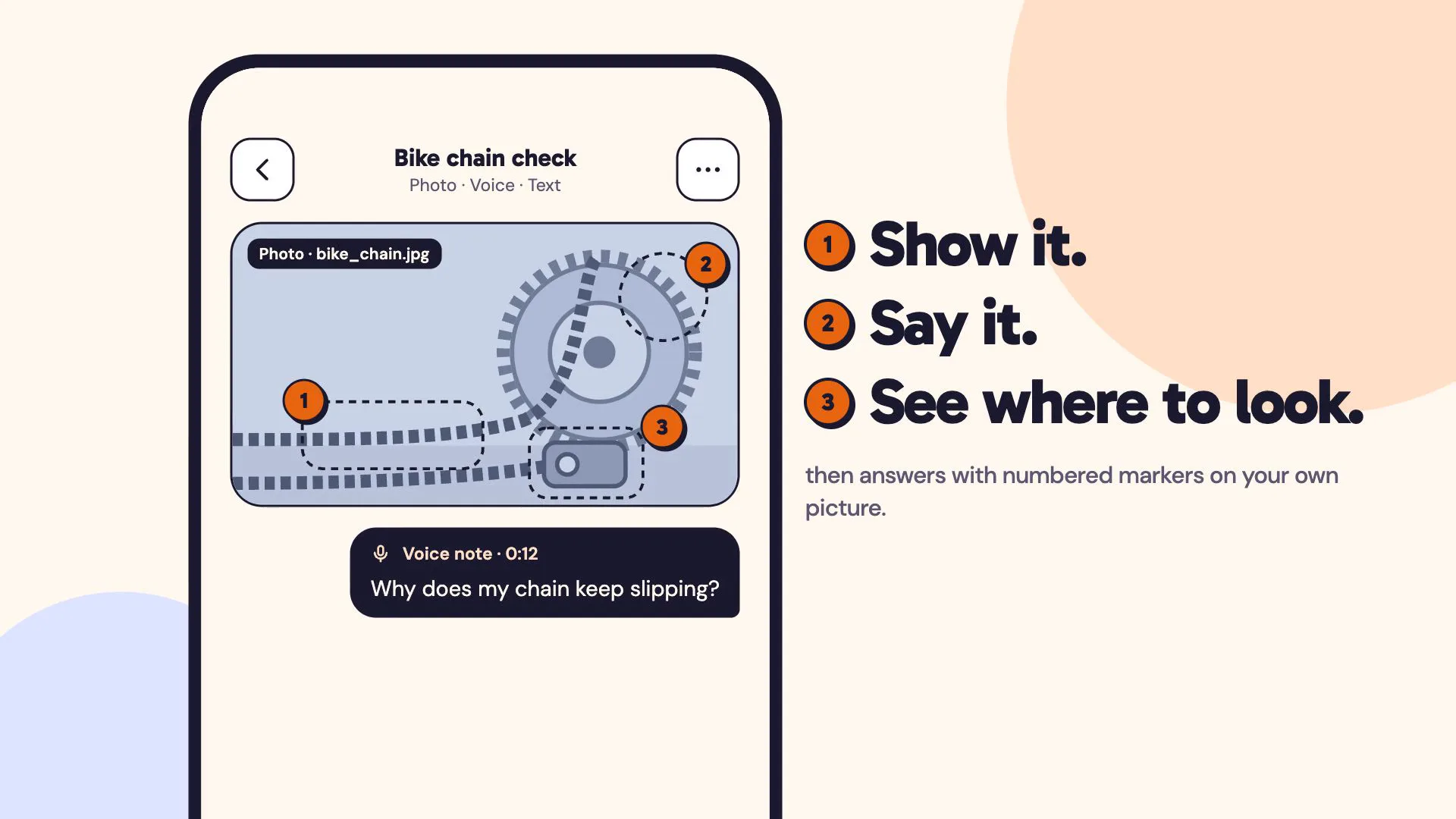
LiveA multimodal AI assistant you can show things to: a photo, a voice note and a line of text in one ask, answered with numbered markers on your own picture.
Mailsort
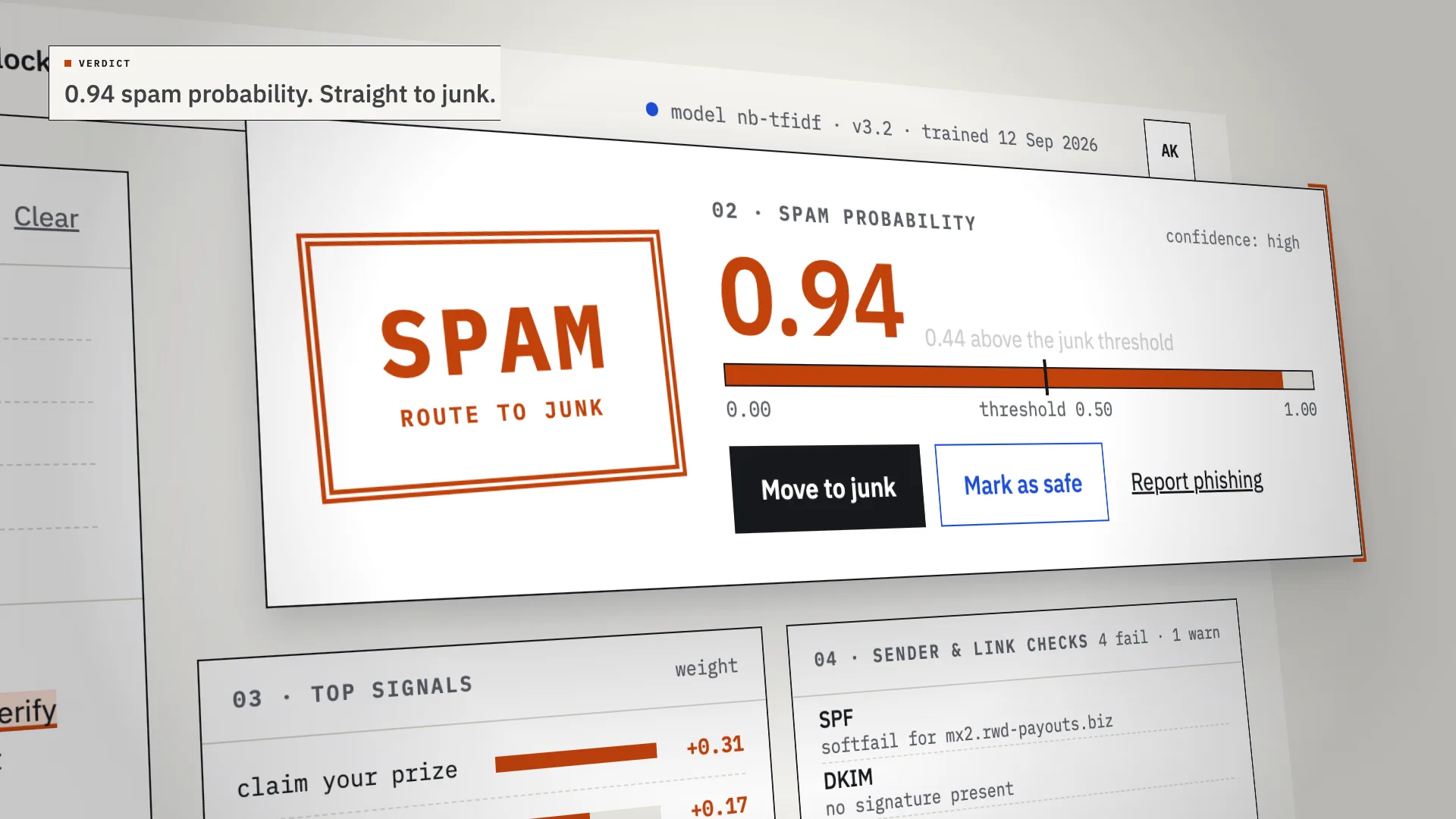
LiveAn AI spam classifier that shows its work: every verdict comes with the phrases, sender checks and links that decided it.
Chalkline
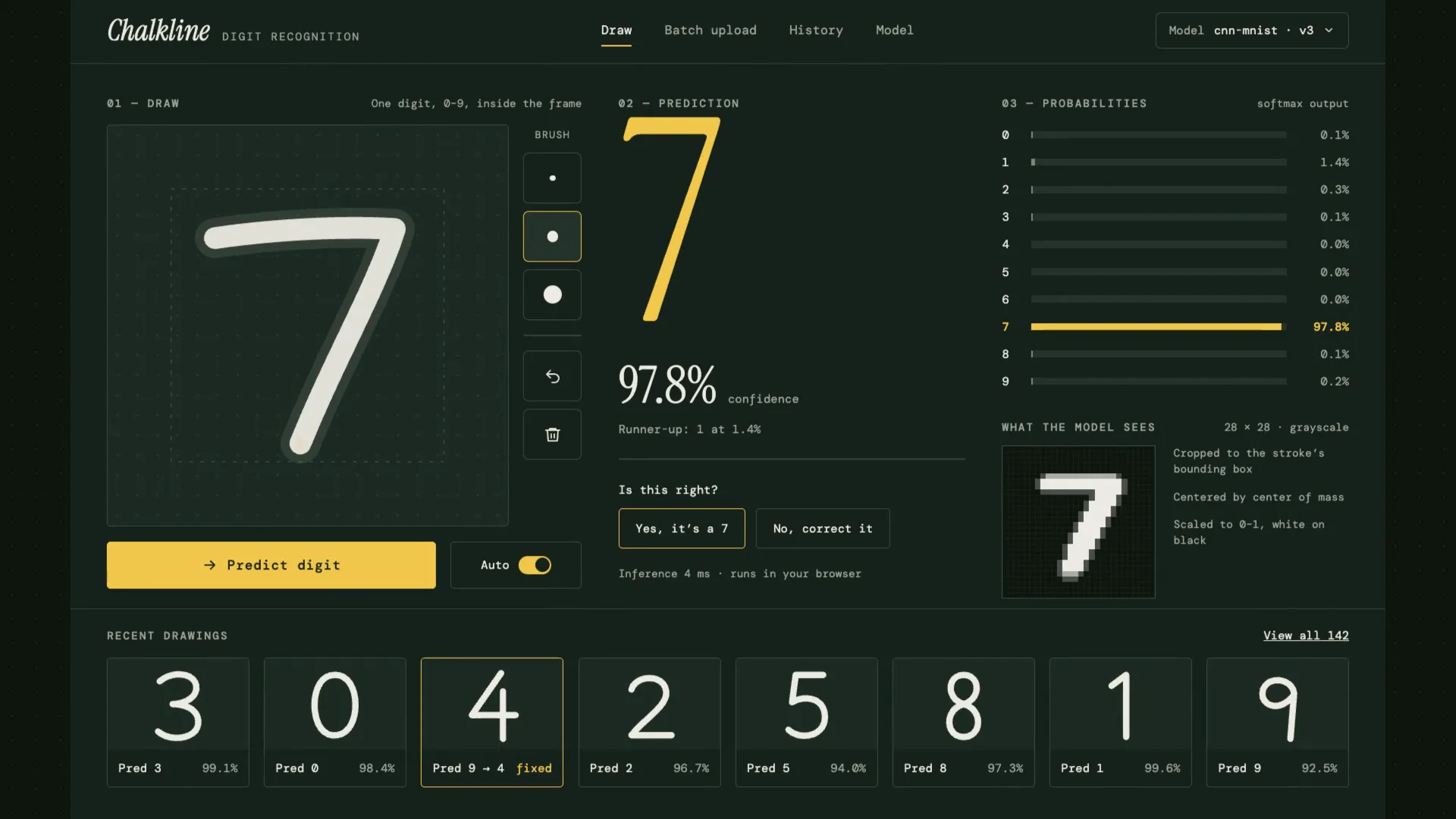
LiveA handwritten digit recognizer that shows its reasoning: your chalk stroke becomes the 28×28 pixels the model sees, then ten probabilities, then an answer.
Have a project like this?
Tell me what you want to build. We map it on a 30-minute call.