

Product
LiveTidewell
An AI support agent for online stores: it answers from your help center and order data, shows its sources, and hands off to your team when it should.
Facts
- Status
- Live
- Platform
- Web app + mobile · site chat widget
- Channels
- Web chat · Email · App
- Flows
- Inbox · Help center · AI training · Reports
- Models
- tw-answer 3.2 · tw-retrieve 2.1 · tw-judge 1.4
- Handoff
- Below the confidence threshold, on a guidance rule, or on request
- Year
- 2026
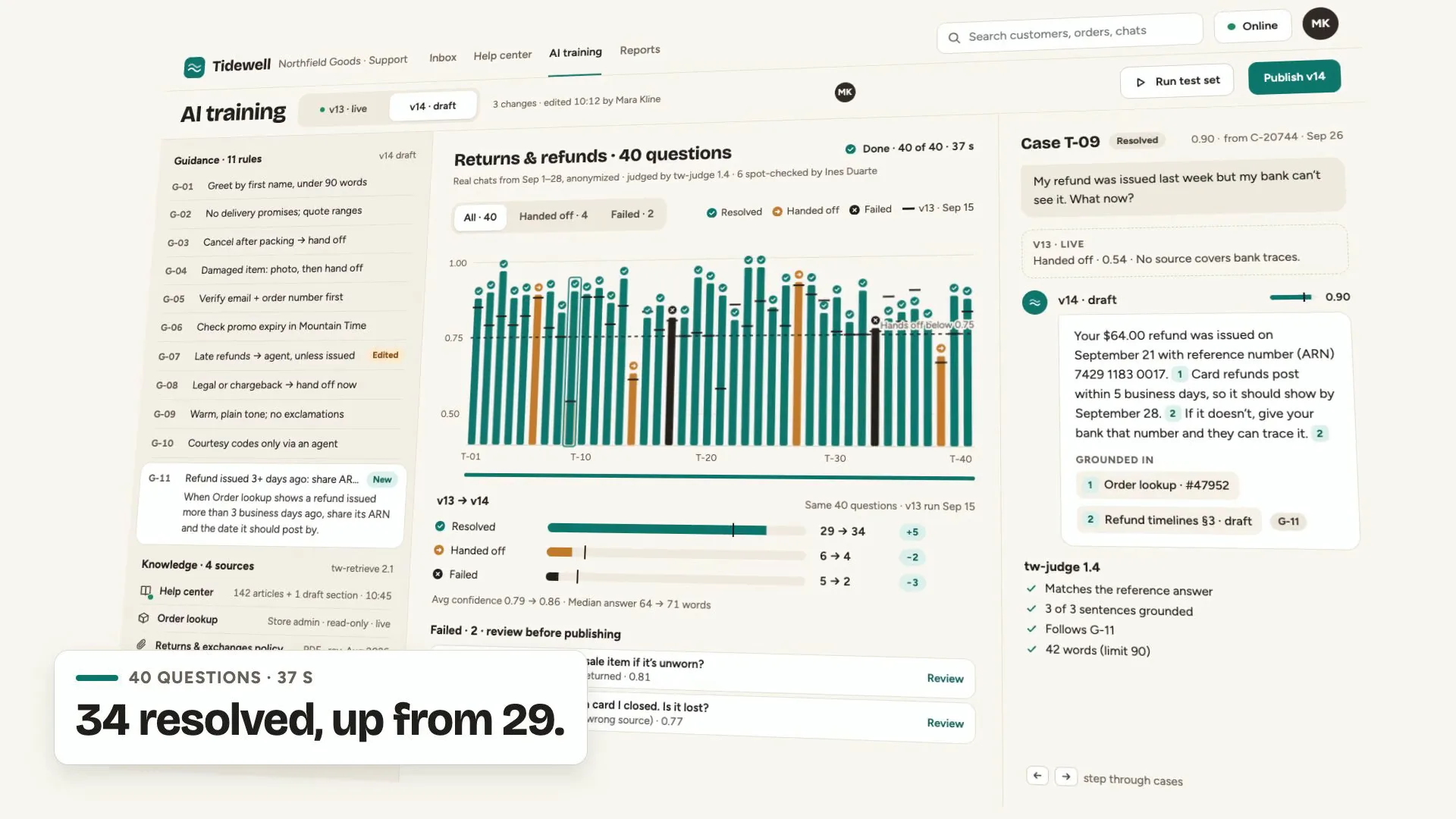
FIG. 01 / PRODUCT FILM
Muted preview · play with sound for the full cut
Who it's for
Support leads and agents at online stores whose customers ask about orders, returns, refunds and shipping in web chat, email or the app. For a team that wants the AI to answer what the store's own sources cover, show where every answer came from, and hand everything else to a person with the story already written.
The problem
A store's support questions — where is my order, where is my refund, do you ship there — already have answers in its help center and its order data. A chatbot that guesses sounds just as sure when it is wrong, and when it gives up, the customer explains everything again to a person who starts from zero. The questions it cannot answer disappear instead of turning into better articles.
The product
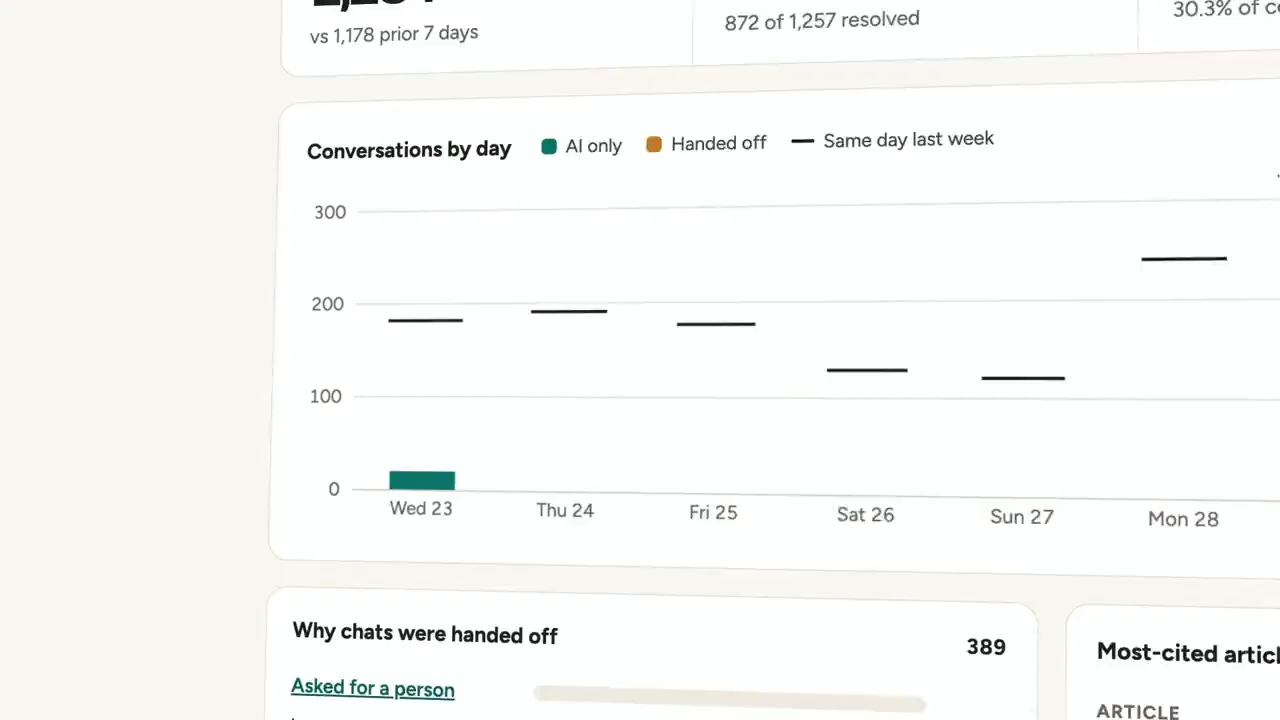
Tidewell answers web chat, email and in-app messages from your help center, a read-only order lookup and your store policies, and every sentence in an answer carries a numbered citation to the source it came from, with a confidence score beside the reply. When that score falls below the threshold you set, a guidance rule applies or the customer asks for a person, the AI pauses and hands the chat to an agent with a summary, the order timeline and suggested replies. Questions it cannot answer become knowledge gaps in the help center, where it drafts the missing section from your agents' own replies, and every change to its guidance runs against a test set of real, anonymized chats, judged answer by answer, before it goes live. Reports shows the week: AI resolution, handoffs and why they happened, customer ratings and the most-cited articles.
FIG. 02 / HOW IT WORKS
How it works
Step 1: Inbox
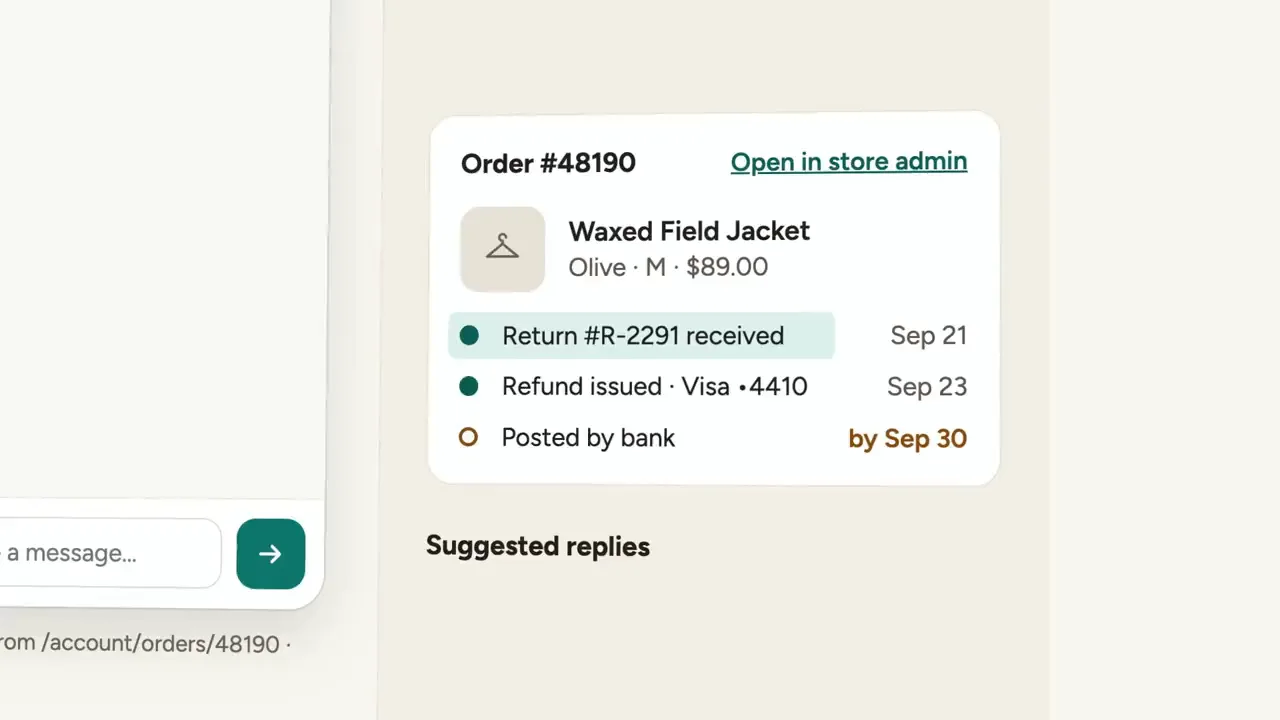
Every answer is built from sources. Tidewell reads the order and the help center, and each sentence settles in only once its source is attached, numbered to a citation under the reply, with a confidence score beside it. When the score falls under the threshold, a guidance rule applies or the customer asks for a person, the AI pauses and the chat passes to an agent with a summary, the order timeline and three suggested replies.
Step 2: Help center
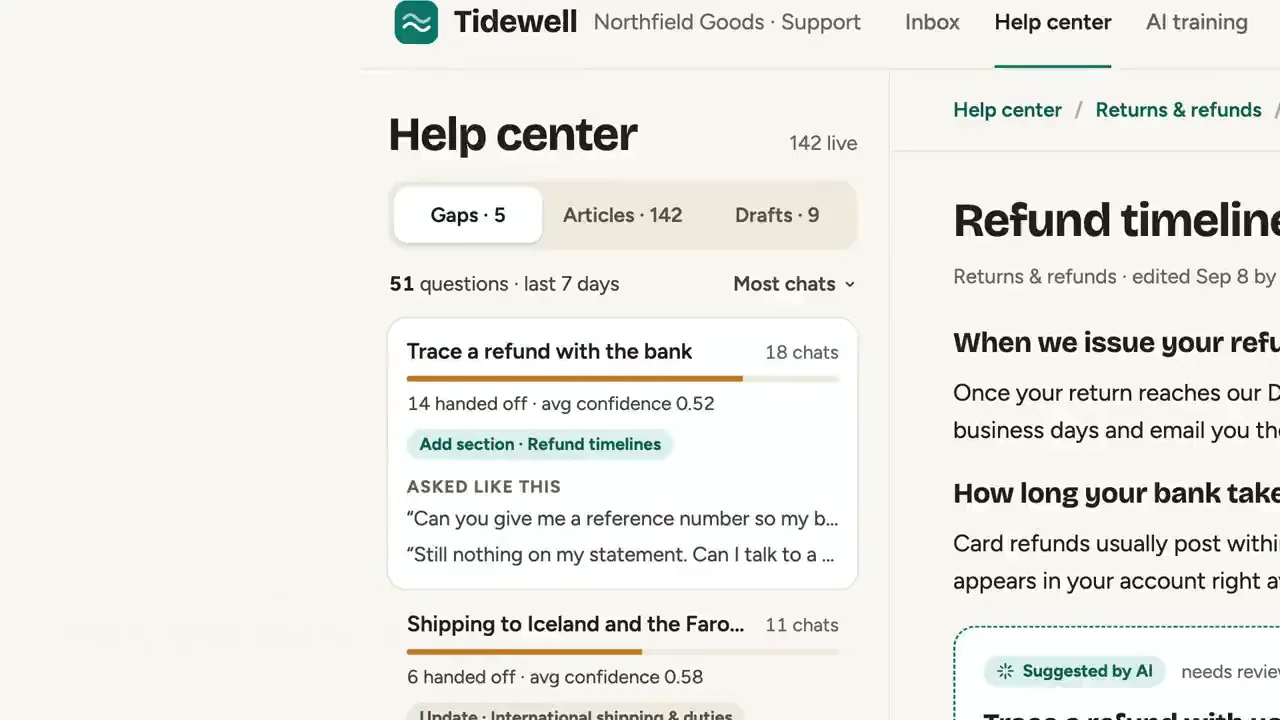
Questions the AI cannot answer are grouped into knowledge gaps, with how many chats asked each one and how many were handed off. For a gap, Tidewell drafts the missing article section from your agents' own replies, citing the reply behind every sentence, and previews how the AI answers with the section in place — its confidence against the handoff line. The draft is replayed on the past chats that asked it, and nothing goes live until someone accepts and publishes it.
Step 3: AI training
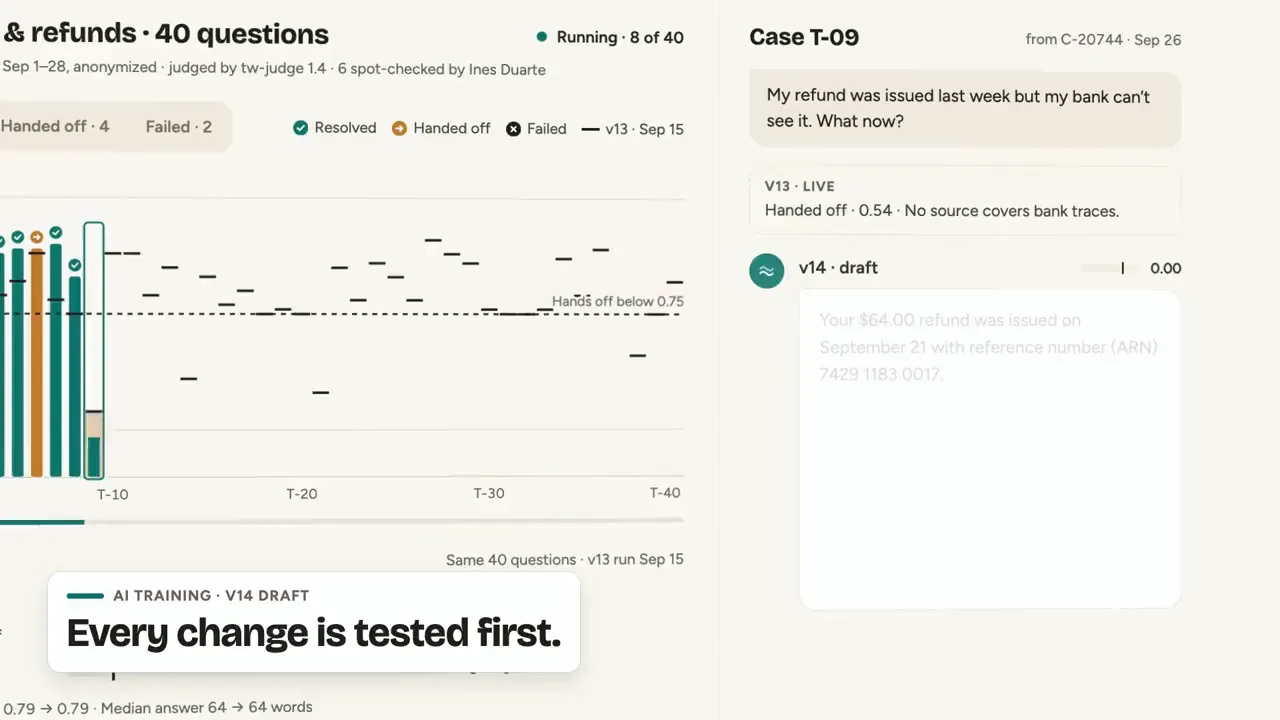
Changes to the AI's guidance — its rules for tone, handoffs and what it may promise — run against a test set of real, anonymized chats before they go live. Each answer is judged against a reference: is it grounded, does it follow the rules, is it within the word limit. The run shows every question's confidence against the handoff line, the live version's level beside the new one and the failures to review; publishing unlocks when the run is done.
FIG. 03 / SCREENS
The product, screen by screen
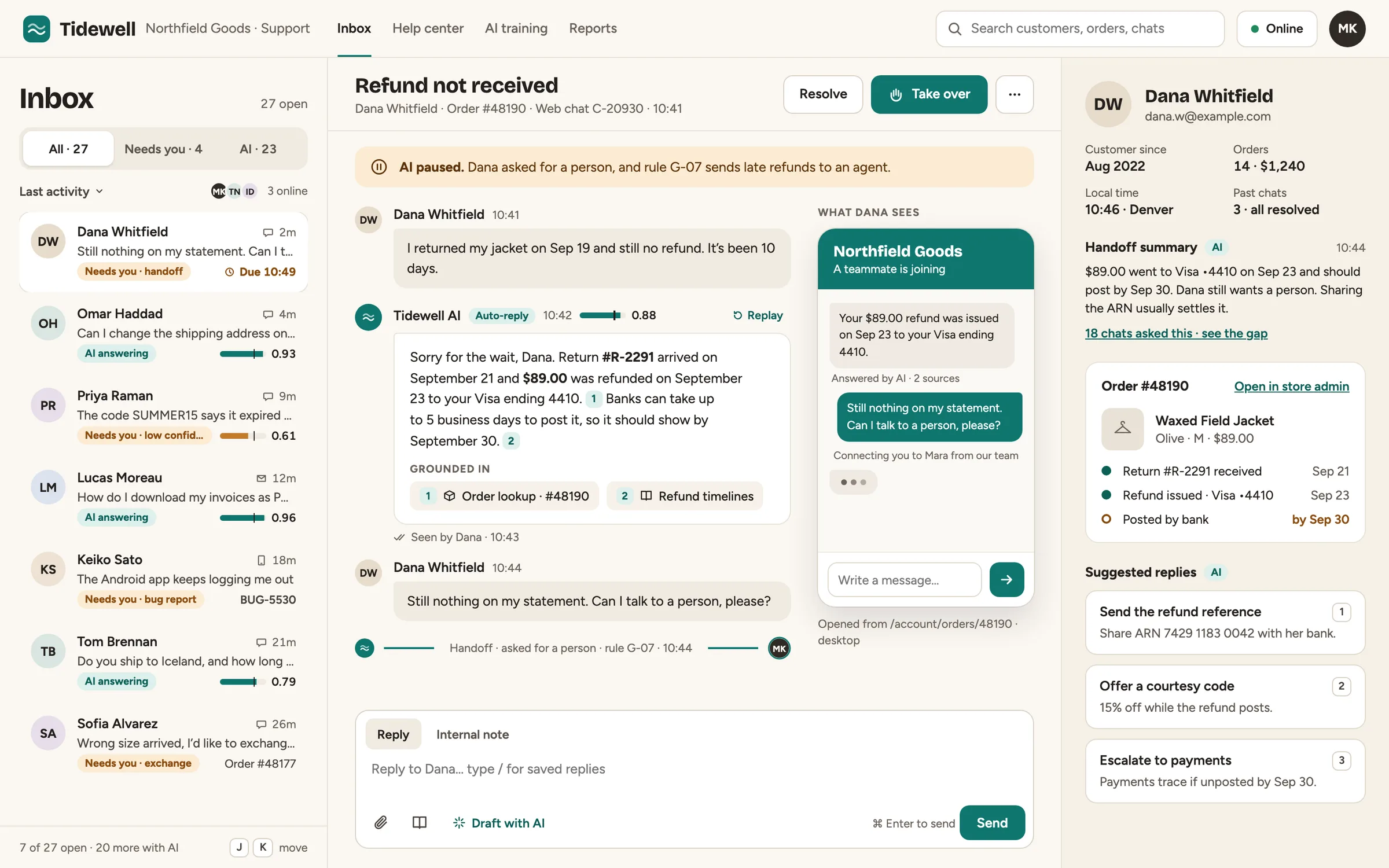
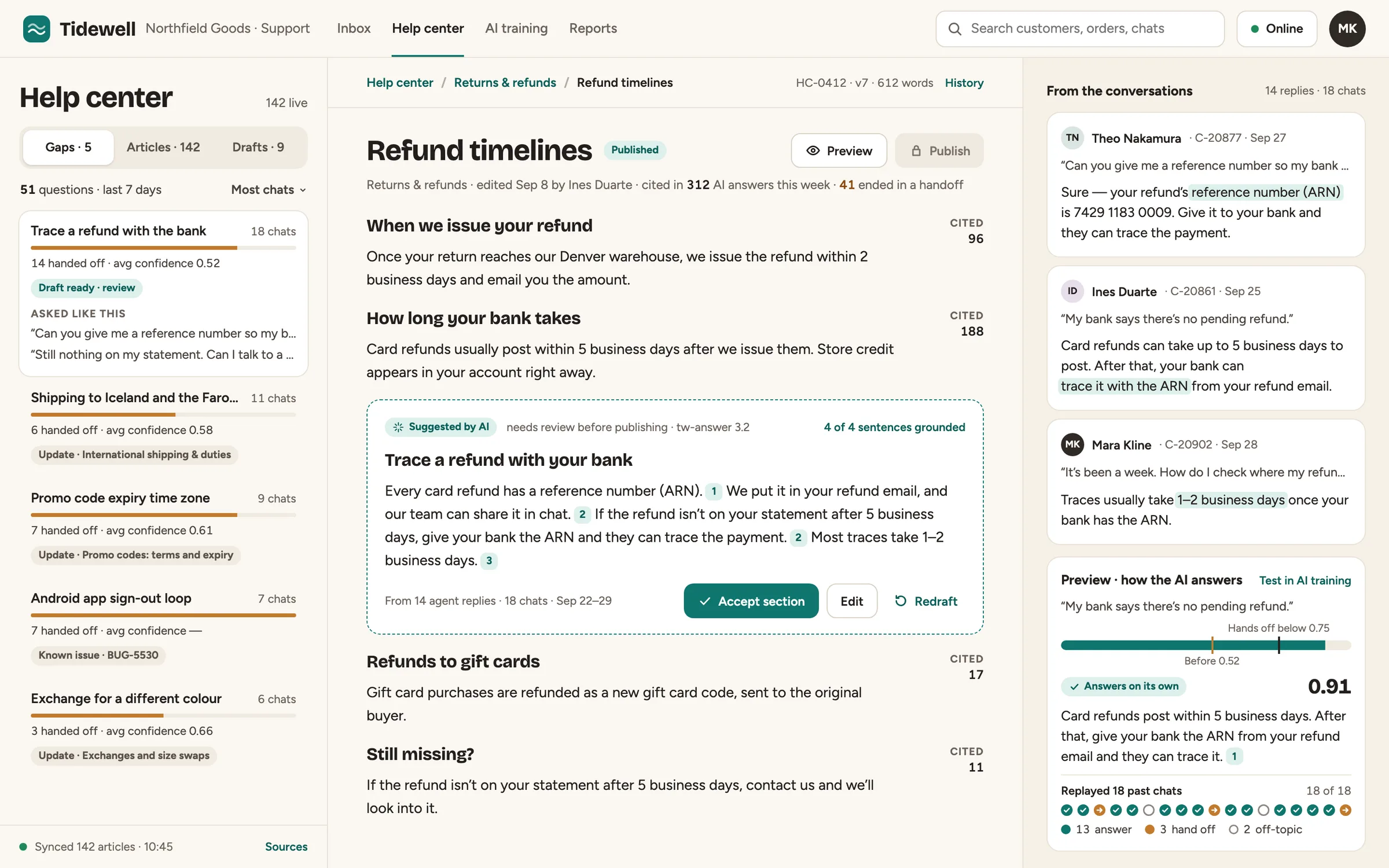
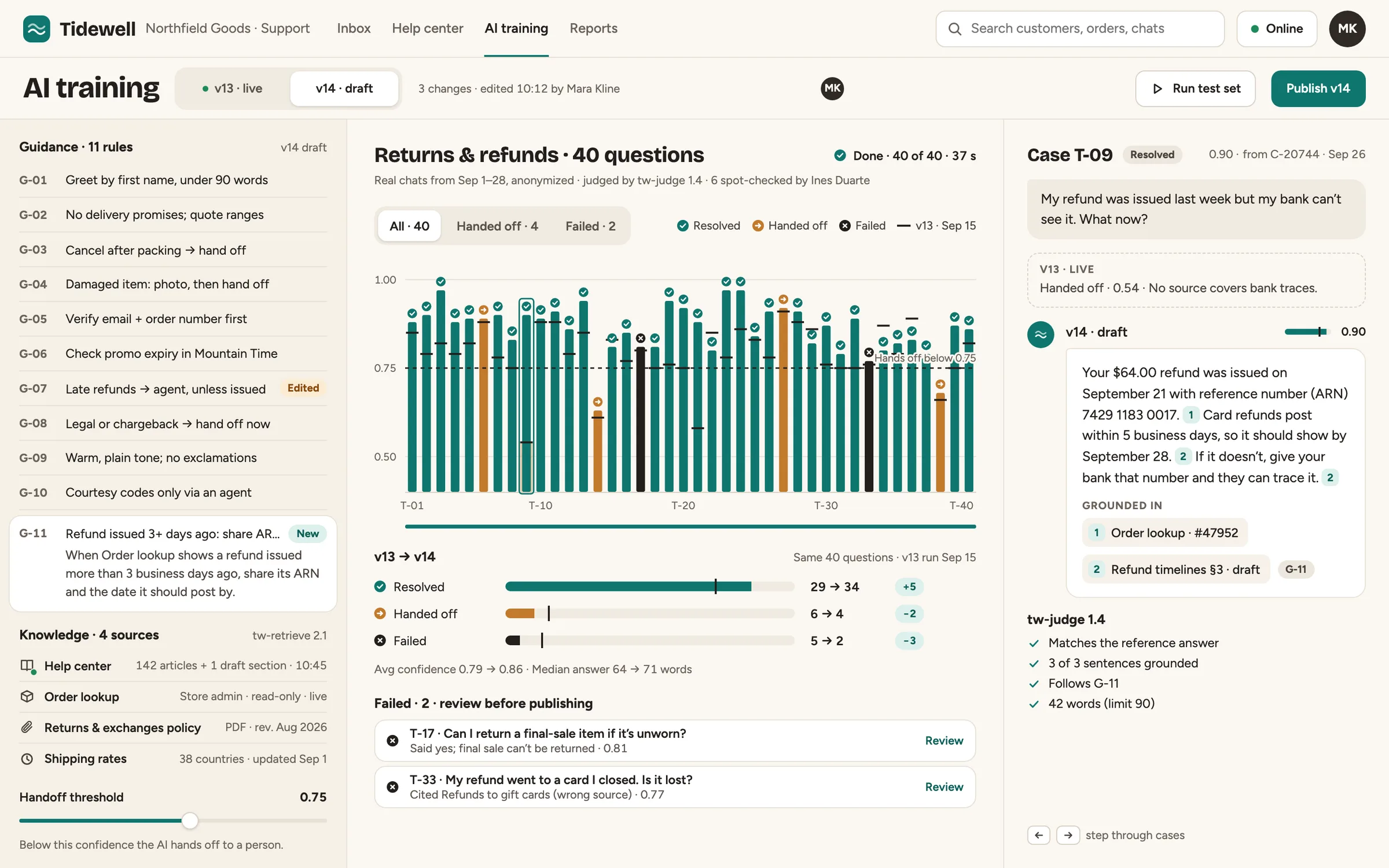
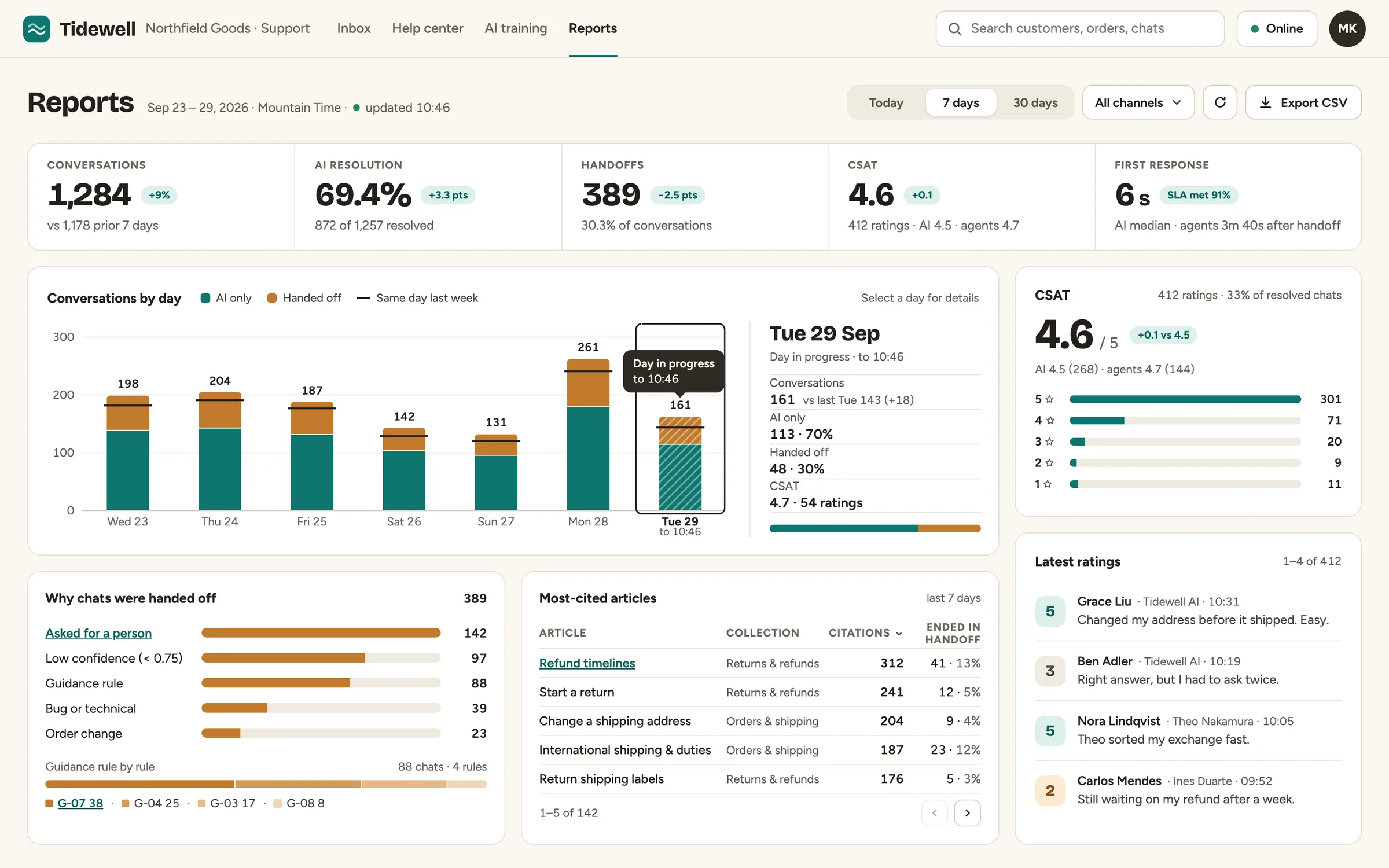
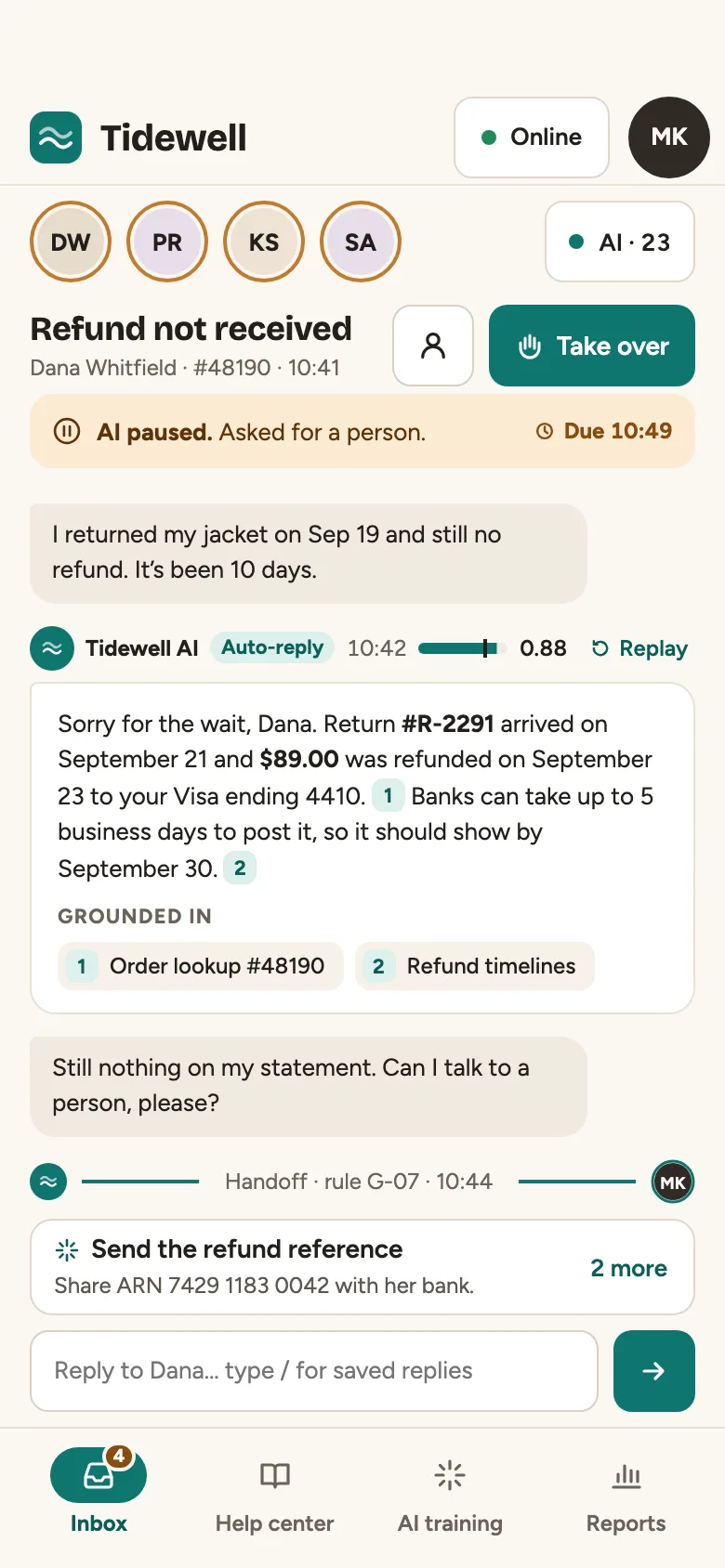
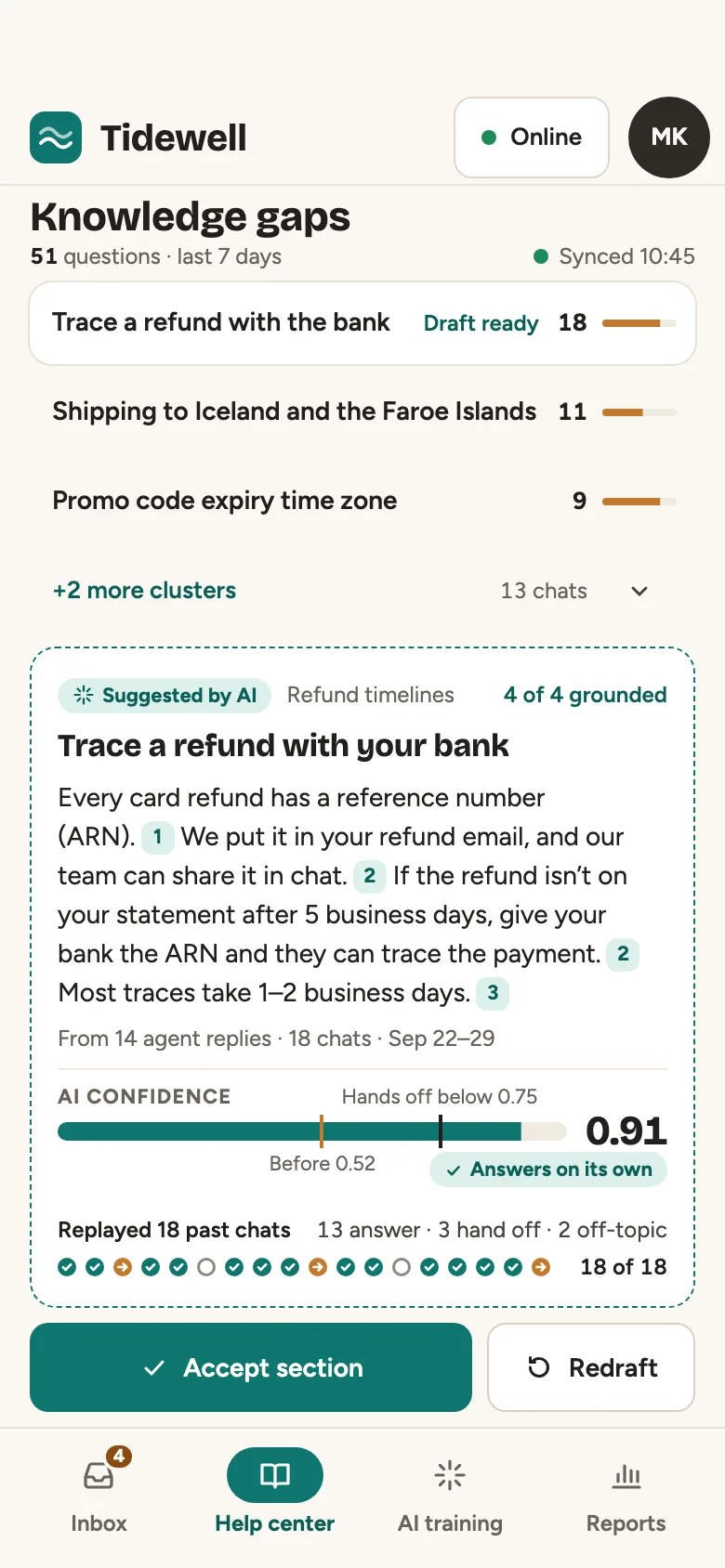
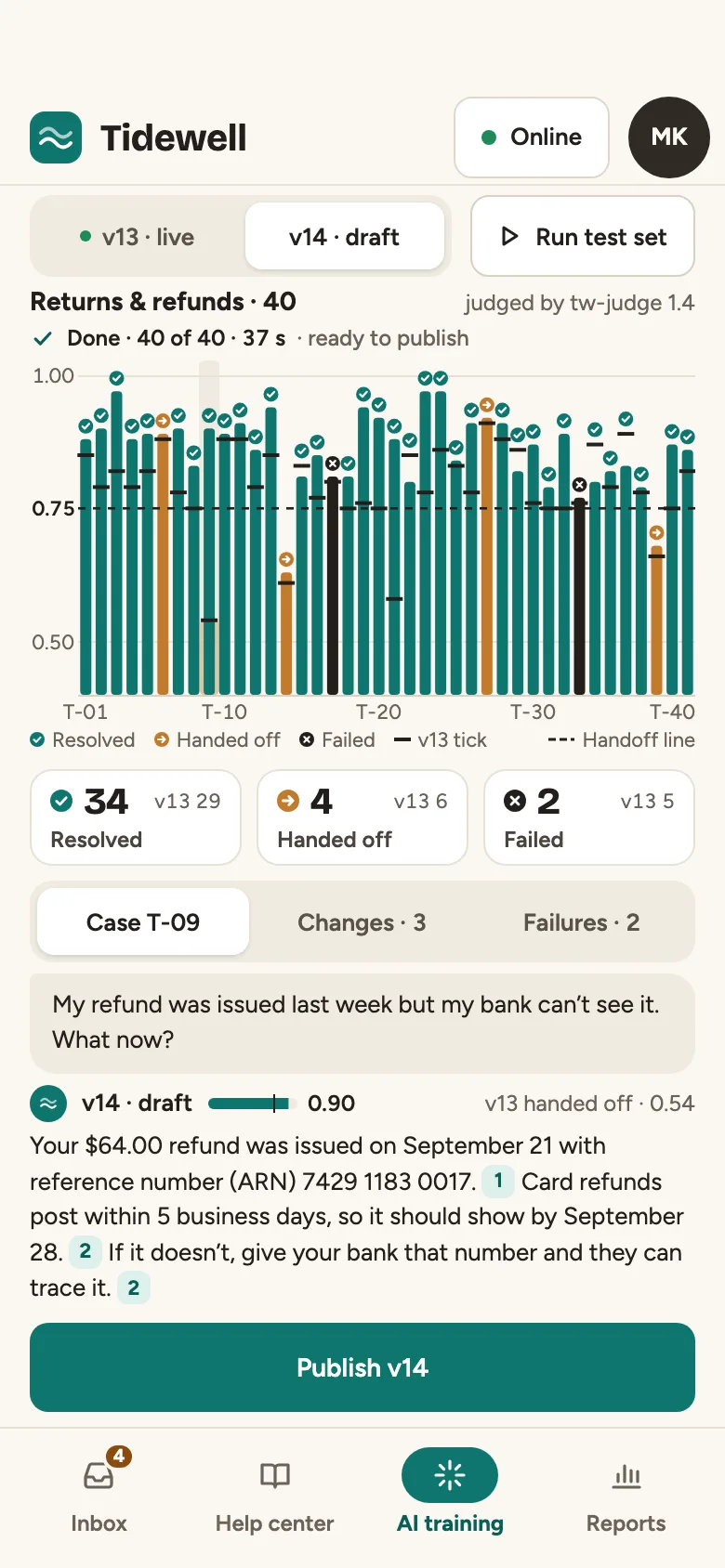
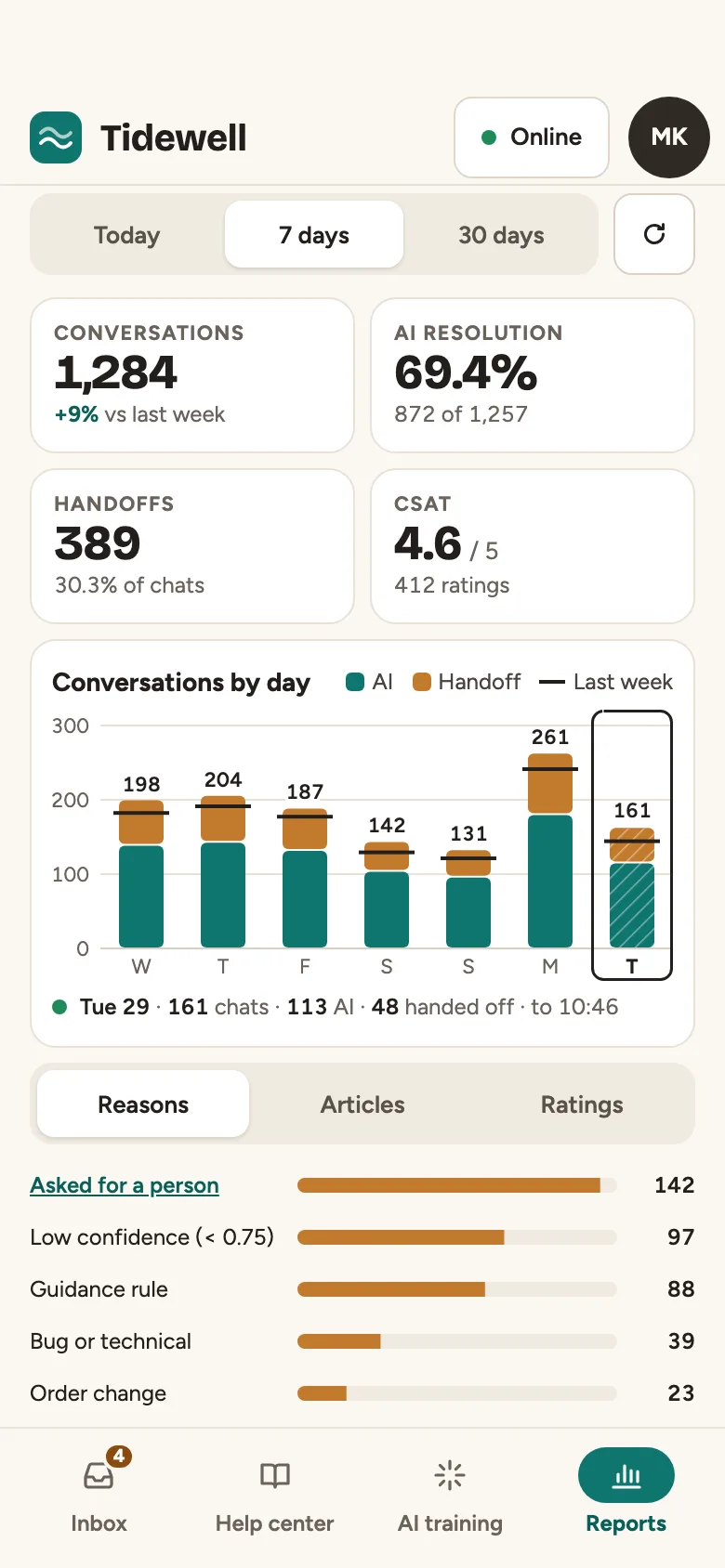
FIG. 04 / DESIGN DIRECTION
Design direction
Warm and calm: a paper-warm background, white cards on hairline rules, and no gradients, glows or heavy shadows. Bricolage Grotesque carries the wordmark, page titles, names and big numbers; Figtree carries everything else, with tabular figures on every number that changes. One deep teal belongs to the AI — its avatar, primary actions, citation markers and resolved bars — and amber marks what needs a person: handoffs, due times, low confidence. A dashed teal outline appears only around text the AI suggests, until someone accepts it.
Palette
- Paper#FAF7F2
- Ink#231F1C
- Teal#0F766E
- Citation tint#DDF0EC
- Handoff amber#C27A2C
Type
- Bricolage Grotesque
- Wordmark, page titles, names, big numbers
- Figtree
- Conversations, articles, tables, labels
FIG. 05 / MOTION LANGUAGE
Motion language
“Grounding tide”: Tidewell only says what it can source, and it knows when to let go — the motion shows exactly that. A sentence appears as a faint draft and inks in only when its source docks: a quote chip lifts from the order card or an agent's reply, glides to the answer and becomes its numbered citation. Every level rises from its baseline like water — confidence, test results, a day's conversations — against a visible tide mark, the handoff line or last week's level. A handoff passes as a small baton from the AI to the agent, whose ring then closes. Text never types itself out, and levels settle without bouncing.
Related systems
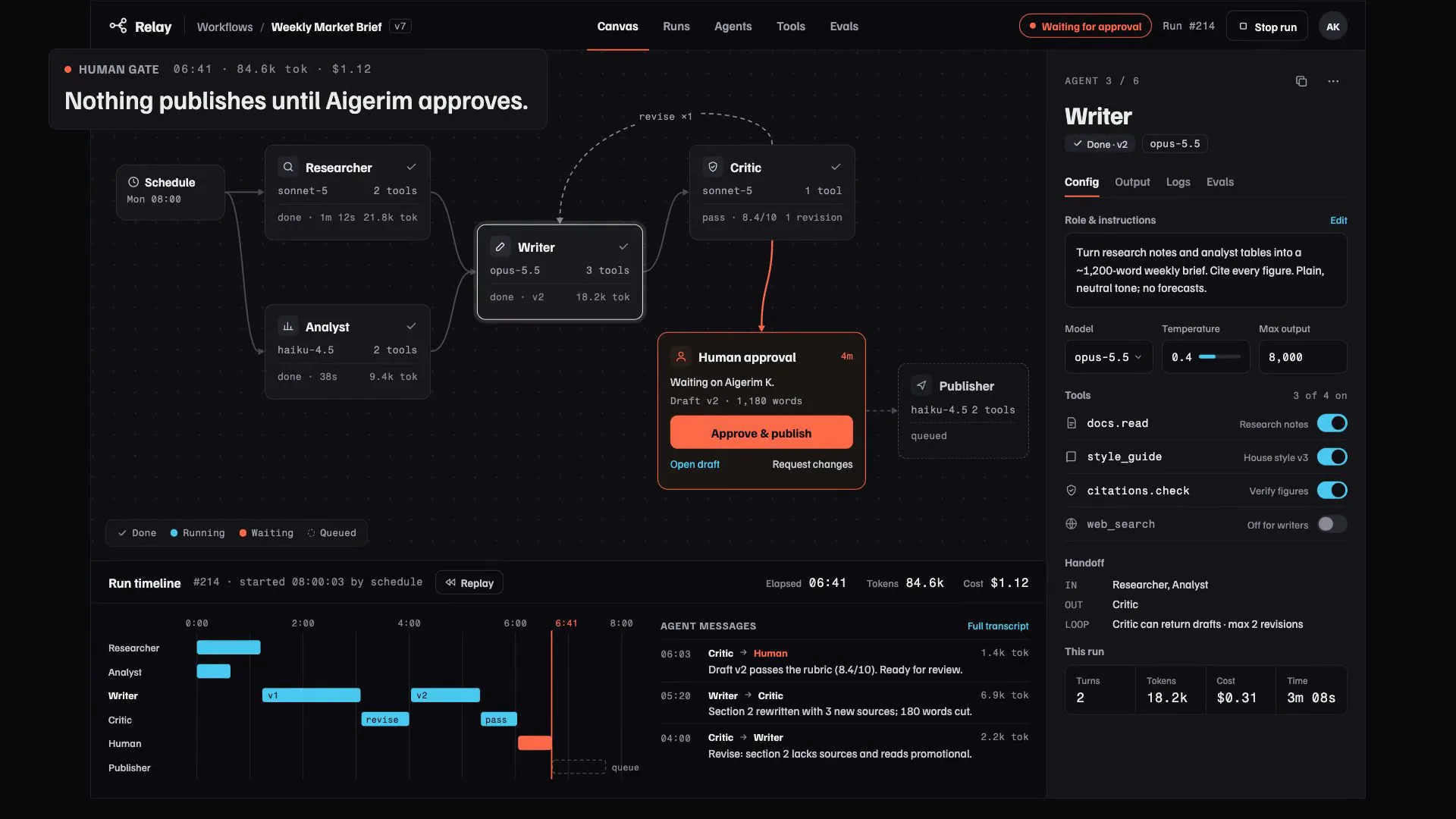
Relay
LiveA control room for multi-agent AI workflows: agents pass work along a visible canvas, every step and cost is traced, and nothing ships until someone signs off.
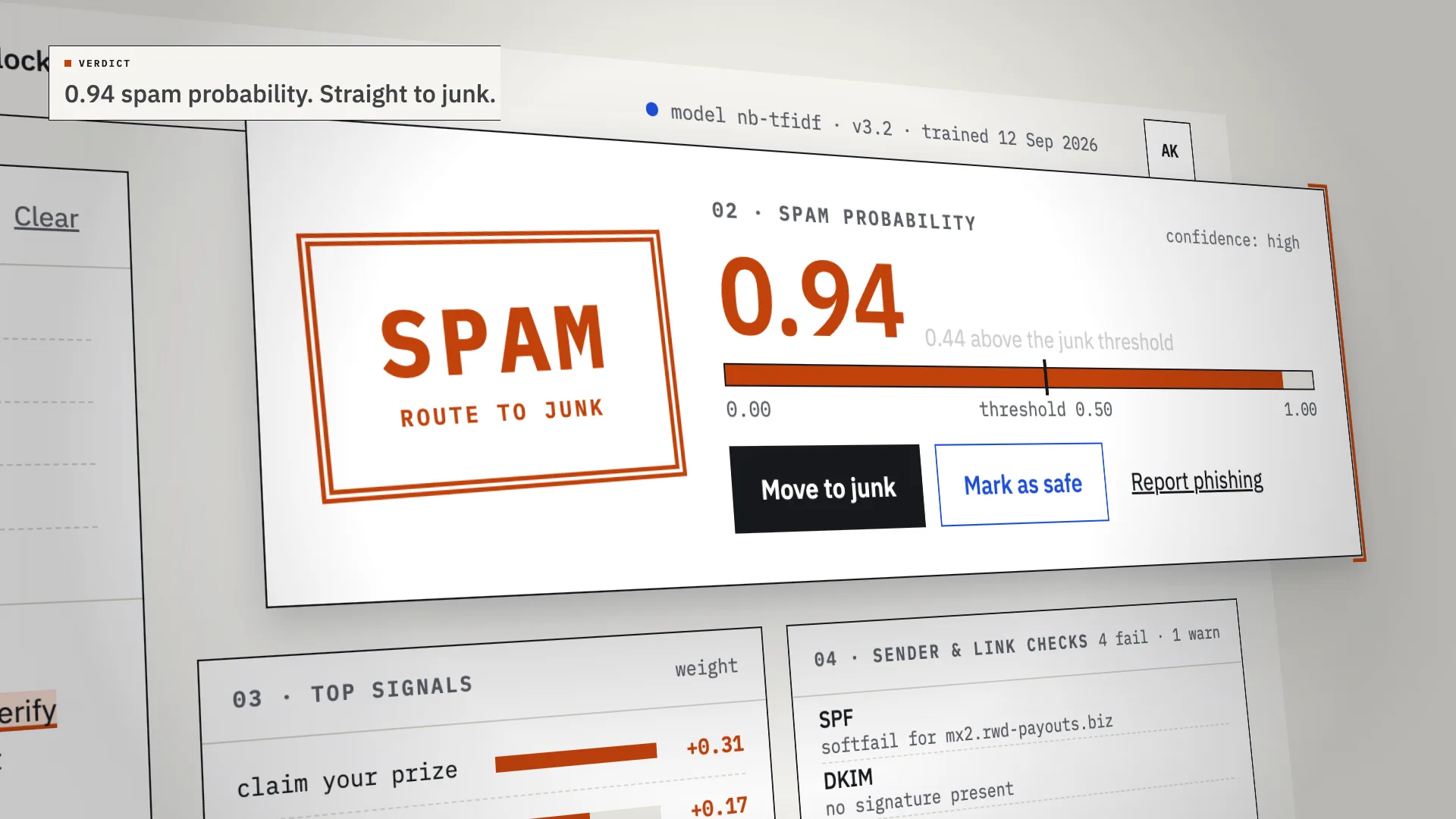
Mailsort
LiveAn AI spam classifier that shows its work: every verdict comes with the phrases, sender checks and links that decided it.
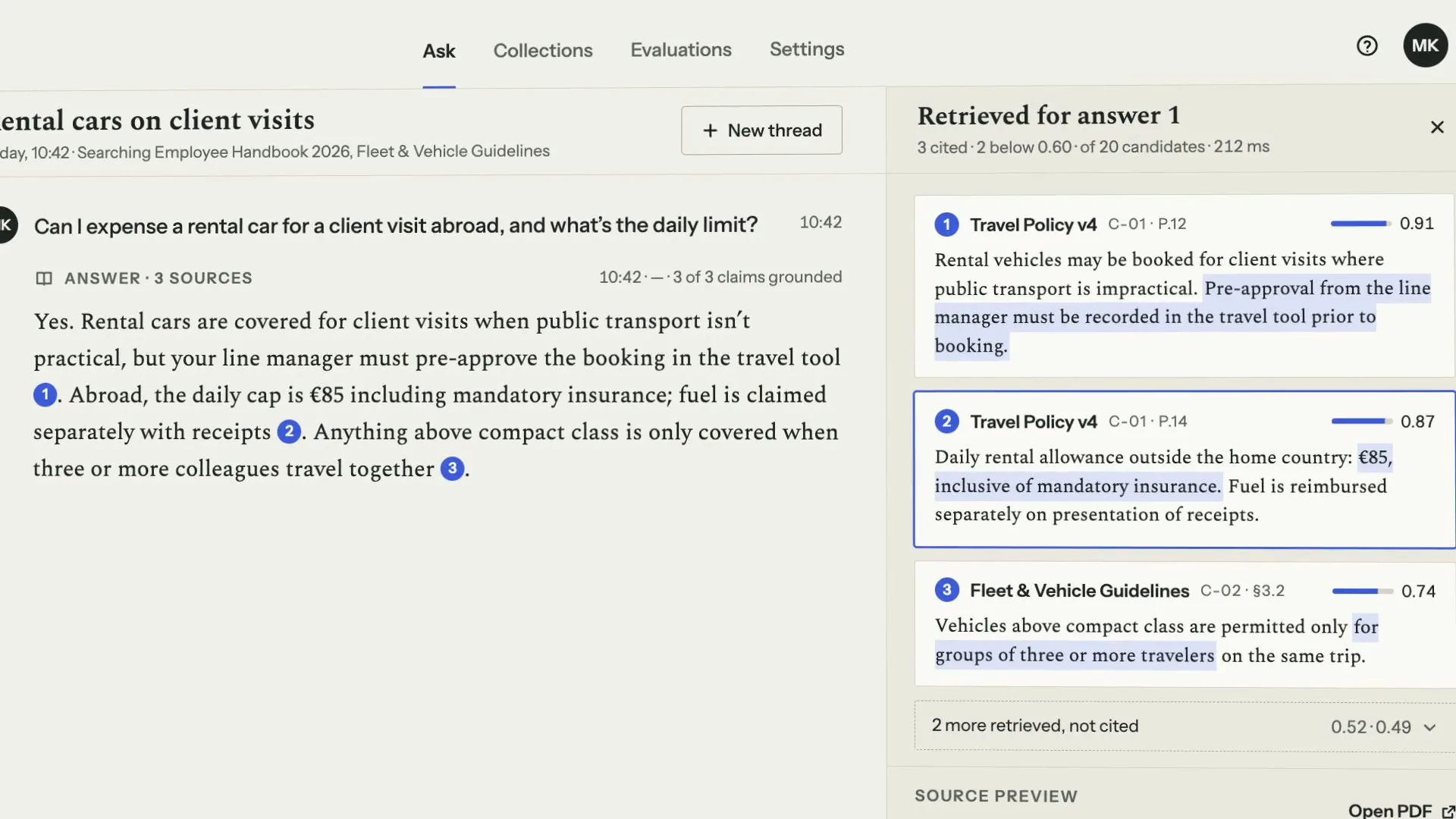
Folio
LiveFolio answers questions from your company's own documents and shows the exact passage behind every sentence, or says it has no source.
Have a project like this?
Tell me what you want to build. We map it on a 30-minute call.